Skip to content

High-quality research proteins.

  • 1-800-805-6531

  • Mon - Sat 8.00-18.00, Sun - Closed

  • info@prospecbio.com

  • PO Box 6591 East Brunswick NJ 08816

  • Products
    • Cytokines
    • Growth factors
    • Chemokines
    • Cd antigens
    • Neurotrophins
    • Hormones
    • Enzymes
    • Viral antigens
    • Recombinant proteins
    • Natural proteins
    • Monoclonal antibodies
    • Polyclonal antibodies
    • Thermal Packaging
  • About
    • Company
    • Founder
    • Contribution
  • Customers
    • Eastern Asia
    • Eastern Europe
    • North America
    • South America
    • South East Asia
    • Southern Asia
    • Western Europe
  • Ordering
    • Ordering Method
    • Ordering - Credit Card
    • Ordering - PO
    • Shipping Fees
    • FAQs
  • Services
    • DNA Cloning
    • Protein Expression
    • Monoclonal Antibody
    • Fermentation
    • Technology License
  • Contact us
Log in

Country/region

  • USD $ | Albania
  • USD $ | Andorra
  • USD $ | Argentina
  • USD $ | Armenia
  • USD $ | Australia
  • USD $ | Austria
  • USD $ | Azerbaijan
  • USD $ | Belarus
  • USD $ | Belgium
  • USD $ | Bolivia
  • USD $ | Brazil
  • USD $ | Bulgaria
  • USD $ | Cambodia
  • USD $ | Canada
  • USD $ | Chile
  • USD $ | China
  • USD $ | Colombia
  • USD $ | Costa Rica
  • USD $ | Croatia
  • USD $ | Cyprus
  • USD $ | Czechia
  • USD $ | Denmark
  • USD $ | Estonia
  • USD $ | Finland
  • USD $ | France
  • USD $ | Georgia
  • USD $ | Germany
  • USD $ | Greece
  • USD $ | Hong Kong SAR
  • USD $ | Hungary
  • USD $ | Iceland
  • USD $ | India
  • USD $ | Ireland
  • USD $ | Israel
  • USD $ | Italy
  • USD $ | Japan
  • USD $ | Kazakhstan
  • USD $ | Latvia
  • USD $ | Liechtenstein
  • USD $ | Lithuania
  • USD $ | Madagascar
  • USD $ | Malta
  • USD $ | Mexico
  • USD $ | Moldova
  • USD $ | Monaco
  • USD $ | Netherlands
  • USD $ | New Zealand
  • USD $ | North Macedonia
  • USD $ | Norway
  • USD $ | Panama
  • USD $ | Paraguay
  • USD $ | Peru
  • USD $ | Philippines
  • USD $ | Poland
  • USD $ | Portugal
  • USD $ | Romania
  • USD $ | Singapore
  • USD $ | Slovakia
  • USD $ | Slovenia
  • USD $ | South Africa
  • USD $ | South Korea
  • USD $ | Spain
  • USD $ | Sri Lanka
  • USD $ | Sweden
  • USD $ | Switzerland
  • USD $ | Taiwan
  • USD $ | Thailand
  • USD $ | Türkiye
  • USD $ | Ukraine
  • USD $ | United Kingdom
  • USD $ | United States
  • USD $ | Uruguay
  • USD $ | Vatican City
  • USD $ | Venezuela
  • USD $ | Vietnam
  • Facebook
  • Instagram
logoProSpec - Recombinant Protein Manufacturer for academic and R&D industry
Become a distributor
Account Log in
Wishlist
Cart Cart(0)
  • Products
    +
    • Cytokines
    • Growth factors
    • Chemokines
    • Cd antigens
    • Neurotrophins
    • Hormones
    • Enzymes
    • Viral antigens
    • Recombinant proteins
    • Natural proteins
    • Monoclonal antibodies
    • Polyclonal antibodies
    • Thermal Packaging
  • About
    +
    • Company
    • Founder
    • Contribution
  • Customers
    +
    • Eastern Asia
    • Eastern Europe
    • North America
    • South America
    • South East Asia
    • Southern Asia
    • Western Europe
  • Ordering
    +
    • Ordering Method
    • Ordering - Credit Card
    • Ordering - PO
    • Shipping Fees
    • FAQs
  • Services
    +
    • DNA Cloning
    • Protein Expression
    • Monoclonal Antibody
    • Fermentation
    • Technology License
  • Contact us

Item added to your cart

View cart
View All
  • Cytokines
  • Growth factors
  • Chemokines
  • Cd antigens
  • Neurotrophins
  • Hormones
  • Enzymes
  • Viral antigens
  • Recombinant proteins
  • Natural proteins
  • Monoclonal antibodies
  • Polyclonal antibodies
  • Thermal Packaging
  • Tumor Necrosis Factor

    Tumor Necrosis Factor

    View All
  • 4-1BB

    4-1BB

    View All
  • Adiponectin

    Adiponectin

    View All
  • AIF1

    AIF1

    View All
  • Other Cytokines

    Other Cytokines

    View All
  • AITRL

    AITRL

    View All
  • Angiopoietin

    Angiopoietin

    View All
  • Apolipoprotein

    Apolipoprotein

    View All
  • B-Cell Activating Factor

    B-Cell Activating Factor

    View All
  • Beta Defensin

    Beta Defensin

    View All
  • Bone Morphogenetic Protein

    Bone Morphogenetic Protein

    View All
  • B type Natriuretic Peptide

    B type Natriuretic Peptide

    View All
  • BST

    BST

    View All
  • Betacellulin

    Betacellulin

    View All
  • Cardiotrophin

    Cardiotrophin

    View All
  • Activin

    Activin

    View All
  • Fibroblast Growth Factor

    Fibroblast Growth Factor

    View All
  • Other Growth Factors

    Other Growth Factors

    View All
  • CSF

    CSF

    View All
  • CTGF

    CTGF

    View All
  • IGFBP

    IGFBP

    View All
  • VEGF Protein

    VEGF Protein

    View All
  • EGF

    EGF

    View All
  • Epigen

    Epigen

    View All
  • Erythropoietin

    Erythropoietin

    View All
  • Insulin-Like Growth Factor

    Insulin-Like Growth Factor

    View All
  • Growth Hormone

    Growth Hormone

    View All
  • HDGF

    HDGF

    View All
  • Hepatocyte Growth Factor

    Hepatocyte Growth Factor

    View All
  • Insulin

    Insulin

    View All
  • BCA-1/ BLC (CXCL13)

    BCA-1/ BLC (CXCL13)

    View All
  • BRAK (CXCL14)

    BRAK (CXCL14)

    View All
  • C-10 (CCL6)

    C-10 (CCL6)

    View All
  • Other Chemokines

    Other Chemokines

    View All
  • MEC (CCL28)

    MEC (CCL28)

    View All
  • LD78-beta (CCL3L1)

    LD78-beta (CCL3L1)

    View All
  • CTACK (CCL27)

    CTACK (CCL27)

    View All
  • CXCL16

    CXCL16

    View All
  • CXCL17

    CXCL17

    View All
  • Platelet Factor-4 (CXCL4)

    Platelet Factor-4 (CXCL4)

    View All
  • ENA-78 (CXCL5)

    ENA-78 (CXCL5)

    View All
  • Eotaxin (CCL11,24,26)

    Eotaxin (CCL11,24,26)

    View All
  • Exodus-2 (CCL21)

    Exodus-2 (CCL21)

    View All
  • Fractalkine (CX3CL1)

    Fractalkine (CX3CL1)

    View All
  • CXCL6

    CXCL6

    View All
  • Other CD Antigens

    Other CD Antigens

    View All
  • CD14

    CD14

    View All
  • CD164

    CD164

    View All
  • CD1

    CD1

    View All
  • CD2

    CD2

    View All
  • CD200

    CD200

    View All
  • CD207

    CD207

    View All
  • CD226

    CD226

    View All
  • CD23

    CD23

    View All
  • CD244

    CD244

    View All
  • CD247

    CD247

    View All
  • CD27

    CD27

    View All
  • CD274

    CD274

    View All
  • CD300

    CD300

    View All
  • CD33

    CD33

    View All
  • Other Neurotrophins

    Other Neurotrophins

    View All
  • Beta-NGF

    Beta-NGF

    View All
  • BDNF

    BDNF

    View All
  • CDNF

    CDNF

    View All
  • CNTF

    CNTF

    View All
  • GDNF

    GDNF

    View All
  • Glia Maturation Factor

    Glia Maturation Factor

    View All
  • MANF

    MANF

    View All
  • Midkine

    Midkine

    View All
  • Neuroglobin

    Neuroglobin

    View All
  • Neurotrophic factors

    Neurotrophic factors

    View All
  • Neuregulin

    Neuregulin

    View All
  • Neuropilin

    Neuropilin

    View All
  • Pigment Epithelium-Derived Factor

    Pigment Epithelium-Derived Factor

    View All
  • Pleiotrophin

    Pleiotrophin

    View All
  • Peptide Hormones

    Peptide Hormones

    View All
  • Other Hormones

    Other Hormones

    View All
  • HCG

    HCG

    View All
  • Endothelin

    Endothelin

    View All
  • Exendin

    Exendin

    View All
  • FSH

    FSH

    View All
  • Glucagon

    Glucagon

    View All
  • GHRP

    GHRP

    View All
  • GLP

    GLP

    View All
  • Thyrostimulin

    Thyrostimulin

    View All
  • Inhibin A

    Inhibin A

    View All
  • LHRH

    LHRH

    View All
  • Melanotan

    Melanotan

    View All
  • Procalcitonin

    Procalcitonin

    View All
  • PTH

    PTH

    View All
  • Peroxiredoxin

    Peroxiredoxin

    View All
  • Peptidase

    Peptidase

    View All
  • Synthetase

    Synthetase

    View All
  • Transferase

    Transferase

    View All
  • Hydrolase

    Hydrolase

    View All
  • Dehydrogenase

    Dehydrogenase

    View All
  • ACE2

    ACE2

    View All
  • Esterase

    Esterase

    View All
  • Protein Kinases

    Protein Kinases

    View All
  • Other Enzymes

    Other Enzymes

    View All
  • Phosphatase

    Phosphatase

    View All
  • Deaminase

    Deaminase

    View All
  • Oxygenase

    Oxygenase

    View All
  • Adenylate Kinase

    Adenylate Kinase

    View All
  • Lyase

    Lyase

    View All
  • Chagas

    Chagas

    View All
  • SARS

    SARS

    View All
  • Influenza

    Influenza

    View All
  • ASFV

    ASFV

    View All
  • Astrovirus

    Astrovirus

    View All
  • Borrelia

    Borrelia

    View All
  • Helicobacter Pylori

    Helicobacter Pylori

    View All
  • Chikungunya

    Chikungunya

    View All
  • Chlamydia

    Chlamydia

    View All
  • Cytomegalo

    Cytomegalo

    View All
  • Dengue

    Dengue

    View All
  • EBV

    EBV

    View All
  • Ebola

    Ebola

    View All
  • Feline Leukemia Virus

    Feline Leukemia Virus

    View All
  • Hepatitis A

    Hepatitis A

    View All
  • Other

    Other

    View All
  • Actin

    Actin

    View All
  • ADAM

    ADAM

    View All
  • Complement Component

    Complement Component

    View All
  • Ag85

    Ag85

    View All
  • Eukaryotic Translation Initiation Factor

    Eukaryotic Translation Initiation Factor

    View All
  • Anterior Gradient Protein

    Anterior Gradient Protein

    View All
  • Heat Shock Protein

    Heat Shock Protein

    View All
  • Alpha-2-HS-Glycoprotein

    Alpha-2-HS-Glycoprotein

    View All
  • Hemoglobin

    Hemoglobin

    View All
  • Allergy

    Allergy

    View All
  • Anaplasma

    Anaplasma

    View All
  • Angiogenin

    Angiogenin

    View All
  • Ankyrin Repeat Domain

    Ankyrin Repeat Domain

    View All
  • Annexin

    Annexin

    View All
  • Other Natural Proteins

    Other Natural Proteins

    View All
  • Aprotinin

    Aprotinin

    View All
  • Transferrin

    Transferrin

    View All
  • Avidin

    Avidin

    View All
  • Anti Coagulation Factors

    Anti Coagulation Factors

    View All
  • Natural Albumin

    Natural Albumin

    View All
  • Natural Coagulation Factors

    Natural Coagulation Factors

    View All
  • Fibronectin

    Fibronectin

    View All
  • Thrombin

    Thrombin

    View All
  • Anti Human Enzyme

    Anti Human Enzyme

    View All
  • Other Monoclonal Antibodies

    Other Monoclonal Antibodies

    View All
  • Anti Human Cytokine

    Anti Human Cytokine

    View All
  • Anti Human Heat Shock Protein

    Anti Human Heat Shock Protein

    View All
  • Anti Mouse Lymphocyte

    Anti Mouse Lymphocyte

    View All
  • Anti Human Chemokine

    Anti Human Chemokine

    View All
  • Anti Human Lymphocyte

    Anti Human Lymphocyte

    View All
  • Anti Viral Monoclonal

    Anti Viral Monoclonal

    View All
  • Anti Mouse Cytokine

    Anti Mouse Cytokine

    View All
  • Anti-GST Monoclonal

    Anti-GST Monoclonal

    View All
  • Other Polyclonal Antibodies

    Other Polyclonal Antibodies

    View All
  • Anti Viral

    Anti Viral

    View All
  • Anti-GST Monoclonal

    Anti-GST Monoclonal

    View All
Back

Search results

273 results found for “PDZ Domain Containing”

Name

Description

Product #

Price

Quantity

Shipping Method

  • View Data Sheet

    Name :

    PDZK1 Human

    Description:

    PDZ Domain Containing 1 Human Recombinant

    PDZ Domain Containing 1, PDZ-Containing Kidney Protein 1, Na(+)/H(+) Exchange Regulatory Cofactor NHE-RF3, Na/Pi Cotransporter C-Terminal-Associated Protein 1, Sodium-Hydrogen Exchanger Regulatory Factor 3, CFTR-Associated Protein Of 70 KDa, NHERF-3, CAP70, PDZD1, CLAMP, naPi-Cap1.

    Product # :

    PRO-1447

    Price :

    Quantity :

    Shipping Method :

    Ice Icon

    Shipped with Ice Packs

    Add To Cart

    More Info

    • description
    • source
    • formulation
    • purity
    • More Info
    • Citations

    Description

    PDZK1 Human Recombinant produced in E.Coli is a single, non-glycosylated polypeptide chain containing 542 amino acids (1-519 a.a.) and having a molecular mass of 59.0kDa.PDZK1 is fused to a 23 amino acid His-tag at N-terminus & purified by proprietary chromatographic techniques.

    Source

    E.coli.

    Formulation

    PDZK1 protein solution (1mg/ml) contains 20mM Tris-HCl buffer, (pH 8.0), 0.1M NaCl, 10% glycerol and 1mM DTT.

    Purity

    Greater than 90% as determined by SDS-PAGE.

    Citations

    More Info

    • Introduction

      PDZK1 is a PDZ domain-containing scaffolding protein which facilitates localization of cell surface proteins and has a key part in cholesterol metabolism by regulating the HDL receptor, scavenger receptor class B type 1. Single nucleotide polymorphism in this gene is linked to metabolic syndrome, and overexpression results in drug resistance of multiple myeloma.

    • Synonyms

      PDZ Domain Containing 1, PDZ-Containing Kidney Protein 1, Na(+)/H(+) Exchange Regulatory Cofactor NHE-RF3, Na/Pi Cotransporter C-Terminal-Associated Protein 1, Sodium-Hydrogen Exchanger Regulatory Factor 3, CFTR-Associated Protein Of 70 KDa, NHERF-3, CAP70, PDZD1, CLAMP, naPi-Cap1.

    • Physical Appearance

      Sterile Filtered colorless solution.

    • Stability

      Store at 4°C if entire vial will be used within 2-4 weeks. Store, frozen at -20°C for longer periods of time. For long term storage it is recommended to add a carrier protein (0.1% HSA or BSA).Avoid multiple freeze-thaw cycles.

    • Amino Acid Sequence

      MGSSHHHHHH SSGLVPRGSH MGSMTSTFNP RECKLSKQEG QNYGFFLRIE KDTEGHLVRV VEKCSPAEKA GLQDGDRVLR INGVFVDKEE HMQVVDLVRK SGNSVTLLVL DGDSYEKAVK TRVDLKELGQ SQKEQGLSDN ILSPVMNGGV QTWTQPRLCY LVKEGGSYGF SLKTVQGKKG VYMTDITPQG VAMRAGVLAD DHLIEVNGEN VEDASHEEVV EKVKKSGSRV MFLLVDKETD KRHVEQKIQF KRETASLKLL PHQPRIVEMK KGSNGYGFYL RAGSEQKGQI IKDIDSGSPA EEAGLKNNDL VVAVNGESVE TLDHDSVVEM IRKGGDQTSL LVVDKETDNM YRLAHFSPFL YYQSQELPNG SVKEAPAPTP TSLEVSSPPD TTEEVDHKPK LCRLAKGENG YGFHLNAIRG LPGSFIKEVQ KGGPADLAGL EDEDVIIEVN GVNVLDEPYE KVVDRIQSSG KNVTLLVCGK KAYDYFQAKK IPIVSSLADP LDTPPDSKEG IVVESNHDSH MAKERAHSTA SHSSSNSEDT EM

    ProSpec's products are furnished for LABORATORY RESEARCH USE ONLY. The product may not be used as drugs, agricultural or pesticidal products, food additives or household chemicals.

    Pdzk1 Human
  • View Data Sheet

    Name :

    PDZD11 Human

    Description:

    PDZ Domain Containing 11 Human Recombinant

    PDZ domain-containing protein 11, ATPase-interacting PDZ protein, Plasma membrane calcium ATPase-interacting single-PDZ protein, PMCA-interacting single-PDZ protein, PDZD11, AIPP1, PDZK11, PISP.

    Product # :

    PRO-1263

    Price :

    Quantity :

    Shipping Method :

    Ice Icon

    Shipped with Ice Packs

    Add To Cart

    More Info

    • description
    • source
    • formulation
    • purity
    • More Info
    • Citations

    Description

    PDZD11 Human Recombinant produced in E.Coli is a single, non-glycosylated polypeptide chain containing 163 amino acids (1-140 a.a) and having a molecular mass of 18.5kDa.PDZD11 is fused to a 23 amino acid His-tag at N-terminus & purified by proprietary chromatographic techniques.

    Source

    Escherichia Coli.

    Formulation

    PDZD11 protein solution (0.5mg/ml) containing 20mM Tris-HCl buffer (pH 8.0), 0.15M NaCl, 20% glycerol and 1mM DTT.

    Purity

    Greater than 90.0% as determined by SDS-PAGE.

    Citations

    More Info

    • Introduction

      PDZ Domain Containing 11 (PDZD11) is a cytosolic protein which contains one PDZ (DHR) domain. PDZD11 displays a resemblance to members of the MALS / VELIS family of proteins. PDZD11 contains but one PDZ domain which seemingly interacts with the C-terminus of partner proteins. PDZD11 is ubiquitously expressed and targets calcium and copper ATPases to basolateral cell membranes. PDZD11 is a briefly interacting partner of the PMCA b-splice forms which have a role in their sorting to or from the plasma membrane.

    • Synonyms

      PDZ domain-containing protein 11, ATPase-interacting PDZ protein, Plasma membrane calcium ATPase-interacting single-PDZ protein, PMCA-interacting single-PDZ protein, PDZD11, AIPP1, PDZK11, PISP.

    • Physical Appearance

      Sterile Filtered colorless solution.

    • Stability

      Store at 4°C if entire vial will be used within 2-4 weeks. Store, frozen at -20°C for longer periods of time. For long term storage it is recommended to add a carrier protein (0.1% HSA or BSA).Avoid multiple freeze-thaw cycles.

    • Amino Acid Sequence

      MGSSHHHHHH SSGLVPRGSH MGSMDSRIPY DDYPVVFLPA YENPPAWIPP HERVHHPDYN NELTQFLPRT ITLKKPPGAQ LGFNIRGGKA SQLGIFISKV IPDSDAHRAG LQEGDQVLAV NDVDFQDIEH SKAVEILKTA REISMRVRFF PYNYHRQKER TVH.

    ProSpec's products are furnished for LABORATORY RESEARCH USE ONLY. The product may not be used as drugs, agricultural or pesticidal products, food additives or household chemicals.

    Pdzd11 Human
  • View Data Sheet

    Name :

    GIPC2 Human

    Description:

    GIPC PDZ Domain Member 2 Human Recombinant

    GIPC PDZ domain containing family member 2, SEMCAP-2, PDZ domain-containing protein GIPC2, semaphorin cytoplasmic domain associated protein 2, semaF cytoplasmic domain associated protein 2, SEMCAP2, FLJ20075.

    Product # :

    PRO-1035

    Price :

    Quantity :

    Shipping Method :

    Ice Icon

    Shipped with Ice Packs

    Add To Cart

    More Info

    • description
    • source
    • formulation
    • purity
    • More Info
    • Citations

    Description

    GIPC2 Human Recombinant produced in E.coli is a single, non-glycosylated polypeptide chain containing 339 amino acids (1-315) and having a molecular mass of 36.9kDa.GIPC2 is fused to a 24 amino acid His-tag at N-terminus & purified by proprietary chromatographic techniques.

    Source

    E.coli.

    Formulation

    The GIPC2 solution (1mg/ml) contains 20mM Tris-HCl buffer (pH 8.0), 100mM NaCl, 1mM DTT and 30% glycerol.

    Purity

    Greater than 95% as determined by SDS-PAGE.

    Citations

    More Info

    • Introduction

      GIPC2 is a 315 aa protein which is restricted to the cytoplasm and holds one PDZ domain. GIPC2 is expressed in large quantities in colon and kidney and in small quantities in adult liver. GIPC2 has a vital part in human gastric cancer by control of growth factor signaling or cell adhesion.

    • Synonyms

      GIPC PDZ domain containing family member 2, SEMCAP-2, PDZ domain-containing protein GIPC2, semaphorin cytoplasmic domain associated protein 2, semaF cytoplasmic domain associated protein 2, SEMCAP2, FLJ20075.

    • Physical Appearance

      Sterile Filtered colorless solution.

    • Stability

      Store at 4°C if entire vial will be used within 2-4 weeks. Store, frozen at -20°C for longer periods of time. For long term storage it is recommended to add a carrier protein (0.1% HSA or BSA).Avoid multiple freeze-thaw cycles.

    • Amino Acid Sequence

      MGSSHHHHHH SSGLVPRGSH MGSHMPLKLR GKKKAKSKET AGLVEGEPTG AGGGSLSASR APARRLVFHA QLAHGSATGR VEGFSSIQEL YAQIAGAFEI SPSEILYCTL NTPKIDMERL LGGQLGLEDF IFAHVKGIEK EVNVYKSEDS LGLTITDNGV GYAFIKRIKD GGVIDSVKTI CVGDHIESIN GENIVGWRHY DVAKKLKELK KEELFTMKLI EPKKAFEIEP RSKAGKSSGE KIGCGRATLR LRSKGPATVE EMPSETKAKA IEKIDDVLEL YMGIRDIDLA TTMFEAGKDK VNPDEFAVAL DETLGDFAFP DEFVFDVWGV IGDAKRRGL

    ProSpec's products are furnished for LABORATORY RESEARCH USE ONLY. The product may not be used as drugs, agricultural or pesticidal products, food additives or household chemicals.

    Gipc2 Human
  • View Data Sheet

    Name :

    GIPC1 Human

    Description:

    GIPC PDZ Domain Member 1 Human Recombinant

    PDZ domain-containing protein GIPC1, GAIP C-terminus-interacting protein, RGS-GAIP-interacting protein, RGS19-interacting protein 1, Tax interaction protein 2, TIP-2, GIPC1, C19orf3, GIPC, RGS19IP1, NIP, GIPC, IIP-1, SEMCAP, Hs.6454, MGC3774, GLUT1CBP, MGC15889. SYNECTIN, SYNECTIIN.

    Product # :

    PRO-855

    Price :

    Quantity :

    Shipping Method :

    Ice Icon

    Shipped with Ice Packs

    Add To Cart

    More Info

    • description
    • source
    • formulation
    • purity
    • More Info
    • Citations

    Description

    GIPC1 Recombinant Human produced in E.Coli is a single, non-glycosylated polypeptide chain containing 353 amino acids (1-333 a.a) and having a molecular mass of 38.2kDa. The GIPC1 is fused to a 20 amino acid His-Tag at N-terminus and purified by proprietary chromatographic techniques.

    Source

    Escherichia Coli.

    Formulation

    GIPC1 Human solution (0.5mg/ml) containing 20mM Tris-HCl pH-8, 1mM DTT, 0.1M NaCl, 1mM EDTA & 20% glycerol.

    Purity

    Greater than 95.0% as determined by SDS-PAGE.

    Citations

    More Info

    • Introduction

      GIPC1 is a PDZ domain protein that cooperates with RGS-GAIP and the viral oncoprotein TAX, which transactivates viral and cellular promoters throughout interactions with different transcription factors. GIPC1 particularly localizes to clusters of vesicles close to the plasma membrane and takes part in G protein-coupled signaling pathway participating in regulating Clathrin-coated vesicular trafficking. GIPC1 cooperates with membrane bound Semaphorin F, which is takes part in neuronal axon growth, and controls the subcellular distribution of M-SemF in the brain.

    • Synonyms

      PDZ domain-containing protein GIPC1, GAIP C-terminus-interacting protein, RGS-GAIP-interacting protein, RGS19-interacting protein 1, Tax interaction protein 2, TIP-2, GIPC1, C19orf3, GIPC, RGS19IP1, NIP, GIPC, IIP-1, SEMCAP, Hs.6454, MGC3774, GLUT1CBP, MGC15889. SYNECTIN, SYNECTIIN.

    • Physical Appearance

      Sterile filtered colorless solution.

    • Stability

      Store at 4°C if entire vial will be used within 2-4 weeks. Store, frozen at -20°C for longer periods of time. For long term storage it is recommended to add a carrier protein (0.1% HSA or BSA).Avoid multiple freeze-thaw cycles.

    • Amino Acid Sequence

      MGSSHHHHHH SSGLVPRGSH MPLGLGRRKK APPLVENEEA EPGRGGLGVG EPGPLGGGGS GGPQMGLPPP PPALRPRLVF HTQLAHGSPT GRIEGFTNVK ELYGKIAEAF RLPTAEVMFC TLNTHKVDMD KLLGGQIGLE DFIFAHVKGQ RKEVEVFKSE DALGLTITDN GAGYAFIKRI KEGSVIDHIH LISVGDMIEA INGQSLLGCR HYEVARLLKE LPRGRTFTLK LTEPRKAFDM ISQRSAGGRP GSGPQLGTGR GTLRLRSRGP ATVEDLPSAF EEKAIEKVDD LLESYMGIRD TELAATMVEL GKDKRNPDEL AEALDERLGD FAFPDEFVFD VWGAIGDAKV GRY.

    ProSpec's products are furnished for LABORATORY RESEARCH USE ONLY. The product may not be used as drugs, agricultural or pesticidal products, food additives or household chemicals.

    Gipc1 Human
  • View Data Sheet

    Name :

    PDLIM1 Human

    Description:

    PDZ And LIM Domain 1 Human Recombinant

    PDZ And LIM Domain Protein 1, Carboxyl Terminal LIM Domain Protein 1, Epididymis Secretory Protein Li 112m, C-Terminal LIM Domain Protein 1, LIM Domain Protein CLP-36, hCLIM1, HEL-S-112, CLP-36, Elfin.

    Product # :

    PRO-1848

    Price :

    Quantity :

    Shipping Method :

    Ice Icon

    Shipped with Ice Packs

    Add To Cart

    More Info

    • description
    • source
    • formulation
    • purity
    • More Info
    • Citations

    Description

    PDLIM1 Human Recombinant produced in E.coli is a single, non-glycosylated polypeptide chain containing 354 amino acids (1-329) and having a molecular mass of 38.7 kDa. PDLIM1 is fused to a 25 amino acid His-tag at N-terminus.

    Source

    Escherichia Coli.

    Formulation

    The PDLIM1 solution (1mg/ml) contains 20mM Tris-HCl buffer (pH 7.5), 0.1M NaCl, 1mM DTT, 2mM EDTA and 10% glycerol.

    Purity

    Greater than 85% as determined by SDS-PAGE.

    Citations

    More Info

    • Introduction

      PDLIM1, a cytoplasmic protein linked to the cytoskeleton, belongs to the enigma protein family. PDLIM1 holds two protein interacting domains - PDZ domain at the amino terminal end and one to three LIM domains at the carboxyl terminal. PDLIM1 enables bringing other LIM interacting proteins to the cytoskeleton. Pseudogenes related to PDLIM1 are situated on chromosomes 3, 14 and 17.

    • Synonyms

      PDZ And LIM Domain Protein 1, Carboxyl Terminal LIM Domain Protein 1, Epididymis Secretory Protein Li 112m, C-Terminal LIM Domain Protein 1, LIM Domain Protein CLP-36, hCLIM1, HEL-S-112, CLP-36, Elfin.

    • Physical Appearance

      Sterile Filtered clear solution.

    • Stability

      Store at 4°C if entire vial will be used within 2-4 weeks. Store, frozen at -20°C for longer periods of time. For long term storage it is recommended to add a carrier protein (0.1% HSA or BSA).Avoid multiple freeze-thaw cycles.

    • Amino Acid Sequence

      MGSSHHHHHH SSGLVPRGSH MGSEFMTTQQ IDLQGPGPWG FRLVGGKDFE QPLAISRVTP GSKAALANLC IGDVITAIDG ENTSNMTHLE AQNRIKGCTD NLTLTVARSE HKVWSPLVTE EGKRHPYKMN LASEPQEVLH IGSAHNRSAM PFTASPASST TARVITNQYN NPAGLYSSEN ISNFNNALES KTAASGVEAN SRPLDHAQPP SSLVIDKESE VYKMLQEKQE LNEPPKQSTS FLVLQEILES EEKGDPNKPS GFRSVKAPVT KVAASIGNAQ KLPMCDKCGT GIVGVFVKLR DRHRHPECYV CTDCGTNLKQ KGHFFVEDQI YCEKHARERV TPPEGYEVVT VFPK

    ProSpec's products are furnished for LABORATORY RESEARCH USE ONLY. The product may not be used as drugs, agricultural or pesticidal products, food additives or household chemicals.

    Pdlim1 Human
  • View Data Sheet

    Name :

    WWTR1 Human

    Description:

    WW Domain Containing Transcription Regulator 1 Human Recombinant

    WW domain-containing transcription regulator protein 1, Transcriptional coactivator with PDZ-binding motif, WWTR1, WW Domain Containing Transcription Regulator 1, TAZ.

    Product # :

    PRO-1814

    Price :

    Quantity :

    Shipping Method :

    Ice Icon

    Shipped with Ice Packs

    Add To Cart

    More Info

    • description
    • source
    • formulation
    • purity
    • More Info
    • Citations

    Description

    WWTR1 Human Recombinant produced in E.coli is a single, non-glycosylated polypeptide chain containing 423 amino acids (1-400) and having a molecular mass of 46.5 kDa.WWTR1 is fused to a 23 amino acid His-Tag at N-terminus and purified by proprietary chromatographic techniques.

    Source

    Escherichia Coli.

    Formulation

    The WWTR1 solution (0.5mg/ml) contains 20mM Tris-HCl buffer (pH 8.0), 0.4M UREA and 10% glycerol.

    Purity

    Greater than 85.0% as determined by SDS-PAGE.

    Citations

    More Info

    • Introduction

      WW Domain Containing Transcription Regulator 1 (WWTR1) is a transcriptional coactivator that plays a role as a downstream regulatory target in the Hippo signaling pathway which participates in organ size control and tumor suppression by restricting proliferation and promoting apoptosis. WWTR1 regulates the nuclear accumulation of SMADS and has a main part in coupling them to the transcriptional machinery like the mediator complex. WWTR1 is also regulates embryonic stem-cell self-renewal.

    • Synonyms

      WW domain-containing transcription regulator protein 1, Transcriptional coactivator with PDZ-binding motif, WWTR1, WW Domain Containing Transcription Regulator 1, TAZ.

    • Physical Appearance

      Sterile Filtered colorless solution.

    • Stability

      Store at 4°C if entire vial will be used within 2-4 weeks. Store, frozen at -20°C for longer periods of time. For long term storage it is recommended to add a carrier protein (0.1% HSA or BSA).Avoid multiple freeze-thaw cycles.

    • Amino Acid Sequence

      MGSSHHHHHH SSGLVPRGSH MGSMNPASAP PPLPPPGQQV IHVTQDLDTD LEALFNSVMN PKPSSWRKKI LPESFFKEPD SGSHSRQSST DSSGGHPGPR LAGGAQHVRS HSSPASLQLG TGAGAAGSPA QQHAHLRQQS YDVTDELPLP PGWEMTFTAT GQRYFLNHIE KITTWQDPRK AMNQPLNHMN LHPAVSSTPV PQRSMAVSQP NLVMNHQHQQ QMAPSTLSQQ NHPTQNPPAG LMSMPNALTT QQQQQQKLRL QRIQMERERI RMRQEELMRQ EAALCRQLPM EAETLAPVQA AVNPPTMTPD MRSITNNSSD PFLNGGPYHS REQSTDSGLG LGCYSVPTTP EDFLSNVDEM DTGENAGQTP MNINPQQTRF PDFLDCLPGT NVDLGTLESE DLIPLFNDVE SALNKSEPFL TWL.

    ProSpec's products are furnished for LABORATORY RESEARCH USE ONLY. The product may not be used as drugs, agricultural or pesticidal products, food additives or household chemicals.

    Wwtr1 Human
  • View Data Sheet

    Name :

    PDZK1 Antibody

    Description:

    PDZ Domain Containing 1, Mouse Anti Human

    PDZ Domain Containing 1, PDZ-Containing Kidney Protein 1, Na(+)/H(+) Exchange Regulatory Cofactor NHE-RF3, Na/Pi Cotransporter C-Terminal-Associated Protein 1, Sodium-Hydrogen Exchanger Regulatory Factor 3, CFTR-Associated Protein Of 70 KDa, NHERF-3, CAP70, PDZD1, CLAMP, naPi-Cap1. 

    Product # :

    ANT-460

    Price :

    Quantity :

    Shipping Method :

    Ice Icon

    Shipped with Ice Packs

    Add To Cart

    More Info

    • formulation
    • More Info
    • Citations

    Formulation

    1mg/ml containing PBS, pH-7.4, 10% Glycerol and 0.02% Sodium Azide.

    Citations

    More Info

    • Introduction

      PDZK1 is a PDZ domain-containing scaffolding protein which facilitates localization of cell surface proteins and has a key part in cholesterol metabolism by regulating the HDL receptor, scavenger receptor class B type 1. Single nucleotide polymorphism in this gene is linked to metabolic syndrome, and overexpression results in drug resistance of multiple myeloma.

    • Synonyms

      PDZ Domain Containing 1, PDZ-Containing Kidney Protein 1, Na(+)/H(+) Exchange Regulatory Cofactor NHE-RF3, Na/Pi Cotransporter C-Terminal-Associated Protein 1, Sodium-Hydrogen Exchanger Regulatory Factor 3, CFTR-Associated Protein Of 70 KDa, NHERF-3, CAP70, PDZD1, CLAMP, naPi-Cap1.

    • Physical Appearance

      Sterile Filtered colorless solution.

    • Immunogen

      Anti-human PDZK1 mAb, clone PAT1A2A, is derived from hybridization of mouse F0 myeloma cells with spleen cells from BALB/c mice immunized with a recombinant human PDZK1 protein 1-519 amino acids purified from E. coli.

    • Ig Subclass

      Mouse IgG2b heavy chain and Kappa light chain.

    • Clone

      PAT1A2AT.

    • Applications

      The antibody has been tested by ELISA and Western blot analysis to assure specificity and reactivity. Since application varies, however, each investigation should be titrated by the reagent to obtain optimal results. Recommended starting dilution is 1:1000.

    • Type

      Mouse Anti Human Monoclonal.

    • Storage Procedures

      For periods up to 1 month store at 4°C, for longer periods of time, store at -20°C. Prevent freeze thaw cycles.

    • Purification Method

      PDZK1 antibody was purified from mouse ascitic fluids by protein-A affinity chromatography.

    ProSpec's products are furnished for LABORATORY RESEARCH USE ONLY. The product may not be used as drugs, agricultural or pesticidal products, food additives or household chemicals.

    Pdzk1 Antibody
  • View Data Sheet

    Name :

    CRIPT Human

    Description:

    Cysteine-Rich PDZ-Binding Protein Human Recombinant

    Cysteine-rich interactor of PDZ three, cysteine-rich PDZ-binding protein, Cysteine-rich interactor of PDZ3, postsynaptic protein CRIPT, HSPC139.

    Product # :

    PRO-1105

    Price :

    Quantity :

    Shipping Method :

    Ice Icon

    Shipped with Ice Packs

    Add To Cart

    More Info

    • description
    • source
    • formulation
    • purity
    • More Info
    • Citations

    Description

    CRIPT Human Recombinant produced in E. coli is a single polypeptide chain containing 124 amino acids (1-101) and having a molecular mass of 13.7kDa.CRIPT is fused to a 23 amino acid His-tag at N-terminus & purified by proprietary chromatographic techniques.

    Source

    E.coli.

    Formulation

    The CRIPT solution (1mg/1ml) contains 20mM Tris-HCl buffer (pH 8.0), 100mM NaCl, 1mM DTT and 20% glycerol.

    Purity

    Greater than 95% as determined by SDS-PAGE.

    Citations

    More Info

    • Introduction

      Cysteine-rich PDZ-binding protein, also known as CRIPT, takes part in the cytoskeletal anchoring of DLG4 in excitatory synapses.

    • Synonyms

      Cysteine-rich interactor of PDZ three, cysteine-rich PDZ-binding protein, Cysteine-rich interactor of PDZ3, postsynaptic protein CRIPT, HSPC139.

    • Physical Appearance

      Sterile Filtered colorless solution.

    • Stability

      Store at 4°C if entire vial will be used within 2-4 weeks. Store, frozen at -20°C for longer periods of time. For long term storage it is recommended to add a carrier protein (0.1% HSA or BSA).Avoid multiple freeze-thaw cycles.

    • Amino Acid Sequence

      MGSIHHHHHH SSGLVPRGSH MGSMVCEKCE KKLGTVITPD TWKDGARNTT ESGGRKLNEN KALTSKKARF DPYGKNKFST CRICKSSVHQ PGSHYCQGCA YKKGICAMCG KKVLDTKNYK QTSV

    ProSpec's products are furnished for LABORATORY RESEARCH USE ONLY. The product may not be used as drugs, agricultural or pesticidal products, food additives or household chemicals.

    Cript Human
  • View Data Sheet

    Name :

    PBLD Human

    Description:

    Phenazine Biosynthesis-Like Protein Domain Containing Human Recombinant

    Phenazine biosynthesis-like domain-containing protein, MAWD-binding protein, Unknown protein 32 from 2D-page of liver tissue, PBLD, MAWBP, MAWDBP, FLJ14767, FLJ35507.

    Product # :

    PRO-010

    Price :

    Quantity :

    Shipping Method :

    Ice Icon

    Shipped with Ice Packs

    Add To Cart

    More Info

    • description
    • source
    • formulation
    • purity
    • More Info
    • Citations

    Description

    PBLD Human Recombinant fused with a 20 amino acid His tag at N-terminus produced in E.Coli is a single, non-glycosylated, polypeptide chain containing 308 amino acids (1-288 a.a.) and having a molecular mass of 33.9kDa. The PBLD is purified by proprietary chromatographic techniques.

    Source

    Escherichia Coli.

    Formulation

    The PBLD solution (1 mg/ml) contains 20mM Tris-HCl buffer(pH 8.0), 10% glycerol, 2mM DTT and 0.1M NaCl.

    Purity

    Greater than 95.0% as determined by SDS-PAGE.

    Citations

    More Info

    • Introduction

      PBLD is member of the phenazine biosynthesis-like protein (PhzF) family. PBLD which is expressed in most tissues is the only representative of the PhzF family in the human genome. PBLD participates in the MAPK signaling pathway. PBLD is involved in multiple basic cellular functions, its expression is elevated in several disease processes, including folate deficiency and hypotension.

    • Synonyms

      Phenazine biosynthesis-like domain-containing protein, MAWD-binding protein, Unknown protein 32 from 2D-page of liver tissue, PBLD, MAWBP, MAWDBP, FLJ14767, FLJ35507.

    • Physical Appearance

      Sterile Filtered colorless solution.

    • Stability

      Store at 4°C if entire vial will be used within 2-4 weeks. Store, frozen at -20°C for longer periods of time. For long term storage it is recommended to add a carrier protein (0.1% HSA or BSA).Avoid multiple freeze-thaw cycles.

    • Amino Acid Sequence

      MGSSHHHHHH SSGLVPRGSH MKLPIFIADA FTARAFRGNP AAVCLLENEL DEDMHQKIAR EMNLSETAFI RKLHPTDNFA QSSCFGLRWF TPASEVPLCG HATLASAAVL FHKIKNMNST LTFVTLSGEL RARRAEDGIV LDLPLYPAHP QDFHEVEDLI KTAIGNTLVQ DICYSPDTQK LLVRLSDVYN RSFLENLKVN TENLLQVENT GKVKGLILTL KGEPGGQTQA FDFYSRYFAP WVGVAEDPVT GSAHAVLSSY WSQHLGKKEM HAFQCSHRGG ELGISLRPDG RVDIRGGAAV VLEGTLTA.

    ProSpec's products are furnished for LABORATORY RESEARCH USE ONLY. The product may not be used as drugs, agricultural or pesticidal products, food additives or household chemicals.

    Pbld Human
  • View Data Sheet

    Name :

    JMJD6 Human

    Description:

    Jumonji Domain Containing 6 Human Recombinant

    Jumonji Domain Containing 6, Phosphatidylserine Receptor, Jumonji Domain-Containing Protein 6, Histone Arginine Demethylase JMJD6, Peptide-Lysine 5-Dioxygenase JMJD6, JmjC Domain-Containing Protein 6, Lysyl-Hydroxylase JMJD6, PTDSR, PSR, Bifunctional Arginine Demethylase And Lysyl-Hydroxylase JMJD6, Protein PTDSR, EC 1.14.11.-, EC 1.14.11, KIAA0585, PTDSR1, Bifunctional arginine demethylase and lysyl-hydroxylase JMJD6 (EC:1.14.11.-).

    Product # :

    PRO-2183

    Price :

    Quantity :

    Shipping Method :

    Ice Icon

    Shipped with Ice Packs

    Add To Cart

    More Info

    • description
    • source
    • formulation
    • purity
    • More Info
    • Citations

    Description

    JMJD6 Human Recombinant produced in E.Coli is a single, non-glycosylated polypeptide chain containing 437 amino acids (1-414 a.a) and having a molecular mass of 50.0kDa. JMJD6 is fused to a 23 amino acid His-tag at N-terminus & purified by proprietary chromatographic techniques.

    Source

    Escherichia Coli.

    Formulation

    JMJD6 protein solution (0.5mg/ml) containing Phosphate buffered saline (pH7.4), 30% glycerol and 1mM DTT.

    Purity

    Greater than 90% as determined by SDS-PAGE.

    Citations

    More Info

    • Introduction

      Jumonji Domain Containing 6, also known as JMJD6 performs as a lysyl-hydroxylase which catalyzes 5-hydroxylation on specific lysine residues of target proteins for instance U2AF2/U2AF65 and LUC7L2, as a regulator of RNA splicing by mediating 5-hydroxylation of U2AF2/U2AF65, affecting the pre-mRNA splicing activity of U2AF2/U2AF65. Additionally to peptidyl-lysine 5-dioxygenase activity, JMJD6 performs as an RNA hydroxylase, as proposed by its ability to bind single strand RNA. Furthermore, it acts as an arginine demethylase which demethylates histone H3 at 'Arg-2' (H3R2me) as well as histone H4 at 'Arg-3' (H4R3me), thus taking a part in histone code.

    • Synonyms

      Jumonji Domain Containing 6, Phosphatidylserine Receptor, Jumonji Domain-Containing Protein 6, Histone Arginine Demethylase JMJD6, Peptide-Lysine 5-Dioxygenase JMJD6, JmjC Domain-Containing Protein 6, Lysyl-Hydroxylase JMJD6, PTDSR, PSR, Bifunctional Arginine Demethylase And Lysyl-Hydroxylase JMJD6, Protein PTDSR, EC 1.14.11.-, EC 1.14.11, KIAA0585, PTDSR1, Bifunctional arginine demethylase and lysyl-hydroxylase JMJD6 (EC:1.14.11.-).

    • Physical Appearance

      Sterile filtered colorless solution.

    • Stability

      Store at 4°C if entire vial will be used within 2-4 weeks. Store, frozen at -20°C for longer periods of time. For long term storage it is recommended to add a carrier protein (0.1% HSA or BSA).Avoid multiple freeze-thaw cycles.

    • Amino Acid Sequence

      MGSSHHHHHH SSGLVPRGSH MGSMNHKSKK RIREAKRSAR PELKDSLDWT RHNYYESFSL SPAAVADNVE RADALQLSVE EFVERYERPY KPVVLLNAQE GWSAQEKWTL ERLKRKYRNQ KFKCGEDNDG YSVKMKMKYY IEYMESTRDD SPLYIFDSSY GEHPKRRKLL EDYKVPKFFT DDLFQYAGEK RRPPYRWFVM GPPRSGTGIH IDPLGTSAWN ALVQGHKRWC LFPTSTPREL IKVTRDEGGN QQDEAITWFN VIYPRTQLPT WPPEFKPLEI LQKPGETVFV PGGWWHVVLN LDTTIAITQN FASSTNFPVV WHKTVRGRPK LSRKWYRILK QEHPELAVLA DSVDLQESTG IASDSSSDSS SSSSSSSSDS DSECESGSEG DGTVHRRKKR RTCSMVGNGD TTSQDDCVSK ERSSSRIRDT CGGRAHP.

    ProSpec's products are furnished for LABORATORY RESEARCH USE ONLY. The product may not be used as drugs, agricultural or pesticidal products, food additives or household chemicals.

    Jmjd6 Human
  • View Data Sheet

    Name :

    JOSD1 Human

    Description:

    Josephin Domain Containing 1 Human Recombinant

    Josephin-1, Josephin domain-containing 1, JOSD1, JSPH1, KIAA0063, dJ508I15.2.

    Product # :

    PRO-1251

    Price :

    Quantity :

    Shipping Method :

    Ice Icon

    Shipped with Ice Packs

    Add To Cart

    More Info

    • description
    • source
    • formulation
    • purity
    • More Info
    • Citations

    Description

    JOSD1 Human Recombinant produced in E.Coli is a single, non-glycosylated polypeptide chain containing 225 amino acids (1-202 a.a.) and having a molecular mass of 25.6kDa.JOSD1 is fused to a 23 amino acid His-tag at N-terminus & purified by proprietary chromatographic techniques.

    Source

    Escherichia Coli.

    Formulation

    JOSD1 protein solution (0.5mg/ml) containing 20mM Tris-HCl buffer (pH 8.0), 0.2M NaCl, 40% glycerol, 5mM DTT and 2mM EDTA.

    Purity

    Greater than 90.0% as determined by SDS-PAGE.

    Citations

    More Info

    • Introduction

      Josephin-1 (JOSD1) has minimal protease activity towards poly-ubiquitin chains (in vitro). JOSD1 functions as a deubiquitinating enzyme. Ubiquitin-binding sites in the Josephin domain are a factor in ubiquitin chain binding and cleavage.

    • Synonyms

      Josephin-1, Josephin domain-containing 1, JOSD1, JSPH1, KIAA0063, dJ508I15.2.

    • Physical Appearance

      Sterile Filtered colorless solution.

    • Stability

      Store at 4°C if entire vial will be used within 2-4 weeks. Store, frozen at -20°C for longer periods of time. For long term storage it is recommended to add a carrier protein (0.1% HSA or BSA).Avoid multiple freeze-thaw cycles.

    • Amino Acid Sequence

      MGSSHHHHHH SSGLVPRGSH MGSMSCVPWK GDKAKSESLE LPQAAPPQIY HEKQRRELCA LHALNNVFQD SNAFTRDTLQ EIFQRLSPNT MVTPHKKSML GNGNYDVNVI MAALQTKGYE AVWWDKRRDV GVIALTNVMG FIMNLPSSLC WGPLKLPLKR QHWICVREVG GAYYNLDSKL KMPEWIGGES ELRKFLKHHL RGKNCELLLV VPEEVEAHQS WRTDV.

    ProSpec's products are furnished for LABORATORY RESEARCH USE ONLY. The product may not be used as drugs, agricultural or pesticidal products, food additives or household chemicals.

    Josd1 Human
  • View Data Sheet

    Name :

    CUEDC1 Human

    Description:

    CUE Domain Containing 1 Human Recombinant

    CUE Domain Containing 1, CUE Domain-Containing Protein 1.

    Product # :

    PRO-1822

    Price :

    Quantity :

    Shipping Method :

    Ice Icon

    Shipped with Ice Packs

    Add To Cart

    More Info

    • description
    • source
    • formulation
    • purity
    • More Info
    • Citations

    Description

    CUEDC1 Human Recombinant produced in E.Coli is a single, non-glycosylated polypeptide chain containing 409 amino acids (1-386 a.a) and having a molecular mass of 44.6kDa.CUEDC1 is fused to a 23 amino acid His-tag at N-terminus & purified by proprietary chromatographic techniques.

    Source

    Escherichia Coli.

    Formulation

    CUEDC1 protein solution (0.25mg/ml) containing 20mM Tris-HCl buffer (pH 8.0), 0.15M NaCl, 20% glycerol and 1mM DTT.

    Purity

    Greater than 85% as determined by SDS-PAGE.

    Citations

    More Info

    • Introduction

      CUE Domain Containing 1, also know as CUEDC1 contains 1 CUE domain. The CUE domain is structurally associated to the ubiquitin-binding UBA domain and exists as a domain-swapped dimer which makes additional contacts with ubiquitin, and as a result, binds ubiquitin with higher affinity. The CUE domain is discovered in proteins with diverse functions including protein sorting and degradation of misfolded proteins in the endoplasmic reticulum.

    • Synonyms

      CUE Domain Containing 1, CUE Domain-Containing Protein 1.

    • Physical Appearance

      Sterile Filtered clear solution.

    • Stability

      Store at 4°C if entire vial will be used within 2-4 weeks. Store, frozen at -20°C for longer periods of time.For long term storage it is recommended to add a carrier protein (0.1% HSA or BSA).Please avoid freeze thaw cycles.

    • Amino Acid Sequence

      MGSSHHHHHH SSGLVPRGSH MGSMTSLFRR SSSGSGGGGT AGARGGGGGT AAPQELNNSR PARQVRRLEF NQAMDDFKTM FPNMDYDIIE CVLRANSGAV DATIDQLLQM NLEGGGSSGG VYEDSSDSED SIPPEILERT LEPDSSDEEP PPVYSPPAYH MHVFDRPYPL APPTPPPRID ALGSGAPTSQ RRYRNWNPPL LGNLPDDFLR ILPQQLDSIQ GNAGGPKPGS GEGCPPAMAG PGPGDQESRW KQYLEDERIA LFLQNEEFMK ELQRNRDFLL ALERDRLKYE SQKSKSSSVA VGNDFGFSSP VPGTGDANPA VSEDALFRDK LKHMGKSTRR KLFELARAFS EKTKMRKSKR KHLLKHQSLG AAASTANLLD DVEGHACDED FRGRRQEAPK VEEGLREGQ

    ProSpec's products are furnished for LABORATORY RESEARCH USE ONLY. The product may not be used as drugs, agricultural or pesticidal products, food additives or household chemicals.

    Cuedc1 Human
  • View Data Sheet

    Name :

    PEF1 Human

    Description:

    Penta-EF-Hand Domain Containing 1 Human Recombinant

    Peflin, PEF protein with a long N-terminal hydrophobic domain, Penta-EF hand domain-containing protein 1, PEF1, ABP32, PEF1A.

    Product # :

    PRO-099

    Price :

    Quantity :

    Shipping Method :

    Ice Icon

    Shipped with Ice Packs

    Add To Cart

    More Info

    • description
    • source
    • formulation
    • purity
    • More Info
    • Citations

    Description

    PEF1 Human Recombinant fused with a 36 amino acid His tag at N-terminus produced in E.Coli is a single, non-glycosylated, polypeptide chain containing 320 amino acids (1-284 a.a.) and having a molecular mass of 34.5kDa. The PEF1 is purified by proprietary chromatographic techniques.

    Source

    Escherichia Coli.

    Formulation

    The PEF1 solution (0.25 mg/ml) contains 20mM Tris-HCl buffer (pH 8.0), 1mM DTT, 50% glycerol and 0.2M NaCl.

    Purity

    Greater than 85.0% as determined by SDS-PAGE.

    Citations

    More Info

    • Introduction

      Penta-EF-hand domain containing 1 (PEF1) is a member of the penta-EF-hand protein family, which shares similarities to the apoptosis linked gene ALG-2. PEF1 forms heterodimers with PDCD6/ALG2 and dissociates from PDCD6/ALG2 in the presence of Ca (2+). Furthermore, PEF1 proteins bind calcium and participate in a various calcium-dependent processes in vertebrates.

    • Synonyms

      Peflin, PEF protein with a long N-terminal hydrophobic domain, Penta-EF hand domain-containing protein 1, PEF1, ABP32, PEF1A.

    • Physical Appearance

      Sterile Filtered colorless solution.

    • Stability

      Store at 4°C if entire vial will be used within 2-4 weeks. Store, frozen at -20°C for longer periods of time. For long term storage it is recommended to add a carrier protein (0.1% HSA or BSA).Avoid multiple freeze-thaw cycles.

    • Amino Acid Sequence

      MRGSHHHHHH GMASMTGGQQ MGRDLYDDDD KDRWGSMASY PYRQGCPGAA GQAPGAPPGS
      YYPGPPNSGG QYGSGLPPGG GYGGPAPGGP YGPPAGGGPY GHPNPGMFPS GTPGGPYGGA
      APGGPYGQPP PSSYGAQQPG LYGQGGAPPN VDPEAYSWFQ SVDSDHSGYI SMKELKQALV
      NCNWSSFNDE TCLMMINMFD KTKSGRIDVY GFSALWKFIQ QWKNLFQQYD RDRSGSISYT
      ELQQALSQMG YNLSPQFTQL LVSRYCPRSA NPAMQLDRFI QVCTQLQVLT EAFREKDTAV
      QGNIRLSFED FVTMTASRML.

    ProSpec's products are furnished for LABORATORY RESEARCH USE ONLY. The product may not be used as drugs, agricultural or pesticidal products, food additives or household chemicals.

    Pef1 Human
  • View Data Sheet

    Name :

    PLEKHF2 Human

    Description:

    Pleckstrin Homology Domain Containing Family F Member 2 Human Recombinant

    EAPF, PHAFIN2, ZFYVE18, Pleckstrin homology domain-containing family F member 2, PH domain-containing family F member 2, Endoplasmic reticulum-associated apoptosis-involved protein containing PH and FYVE domains, PH and FYVE domain-containing protein 2, Zinc finger FYVE domain-containing protein 18, PLEKHF2.

    Product # :

    PRO-1874

    Price :

    Quantity :

    Shipping Method :

    Ice Icon

    Shipped with Ice Packs

    Add To Cart

    More Info

    • description
    • source
    • formulation
    • purity
    • More Info
    • Citations

    Description

    PLEKHF2 Human Recombinant produced in E.Coli is a single, non-glycosylated polypeptide chain containing 272 amino acids (1-249 a.a) and having a molecular mass of 30.2kDa. PLEKHF2 is fused to a 23 amino acid His-tag at N-terminus & purified by proprietary chromatographic techniques.

    Source

    Escherichia Coli.

    Formulation

    PLEKHF2 protein solution (0.25mg/ml) containing 20mM Tris-HCl buffer (pH 8.0), 0.15M NaCl, 10% glycerol and 1mM DTT.

    Purity

    Greater than 95.0% as determined by SDS-PAGE.

    Citations

    More Info

    • Introduction

      Pleckstrin Homology Domain Containing Family F Member 2, also known as PLEKHF2, contains 1 FYVE-type zinc finger and 1 PH domain. PLEKHF2 takes part in early endosome fusion upstream of RAB5, regulates receptor trafficking and fluid-phase transport. PLEKHF2 increases cellular sensitivity to TNF-induced apoptosis.

    • Synonyms

      EAPF, PHAFIN2, ZFYVE18, Pleckstrin homology domain-containing family F member 2, PH domain-containing family F member 2, Endoplasmic reticulum-associated apoptosis-involved protein containing PH and FYVE domains, PH and FYVE domain-containing protein 2, Zinc finger FYVE domain-containing protein 18, PLEKHF2.

    • Physical Appearance

      Sterile Filtered colorless solution.

    • Stability

      Store at 4°C if entire vial will be used within 2-4 weeks. Store, frozen at -20°C for longer periods of time. For long term storage it is recommended to add a carrier protein (0.1% HSA or BSA).Avoid multiple freeze-thaw cycles.

    • Amino Acid Sequence

      MGSSHHHHHH SSGLVPRGSH MGSMVDRLAN SEANTRRISI VENCFGAAGQ PLTIPGRVLI GEGVLTKLCR KKPKARQFFL FNDILVYGNI VIQKKKYNKQ HIIPLENVTI DSIKDEGDLR NGWLIKTPTK SFAVYAATAT EKSEWMNHIN KCVTDLLSKS GKTPSNEHAA VWVPDSEATV CMRCQKAKFT PVNRRHHCRK CGFVVCGPCS EKRFLLPSQS SKPVRICDFC YDLLSAGDMA TCQPARSDSY SQSLKSPLND MSDDDDDDDS SD.

    ProSpec's products are furnished for LABORATORY RESEARCH USE ONLY. The product may not be used as drugs, agricultural or pesticidal products, food additives or household chemicals.

    Plekhf2 Human
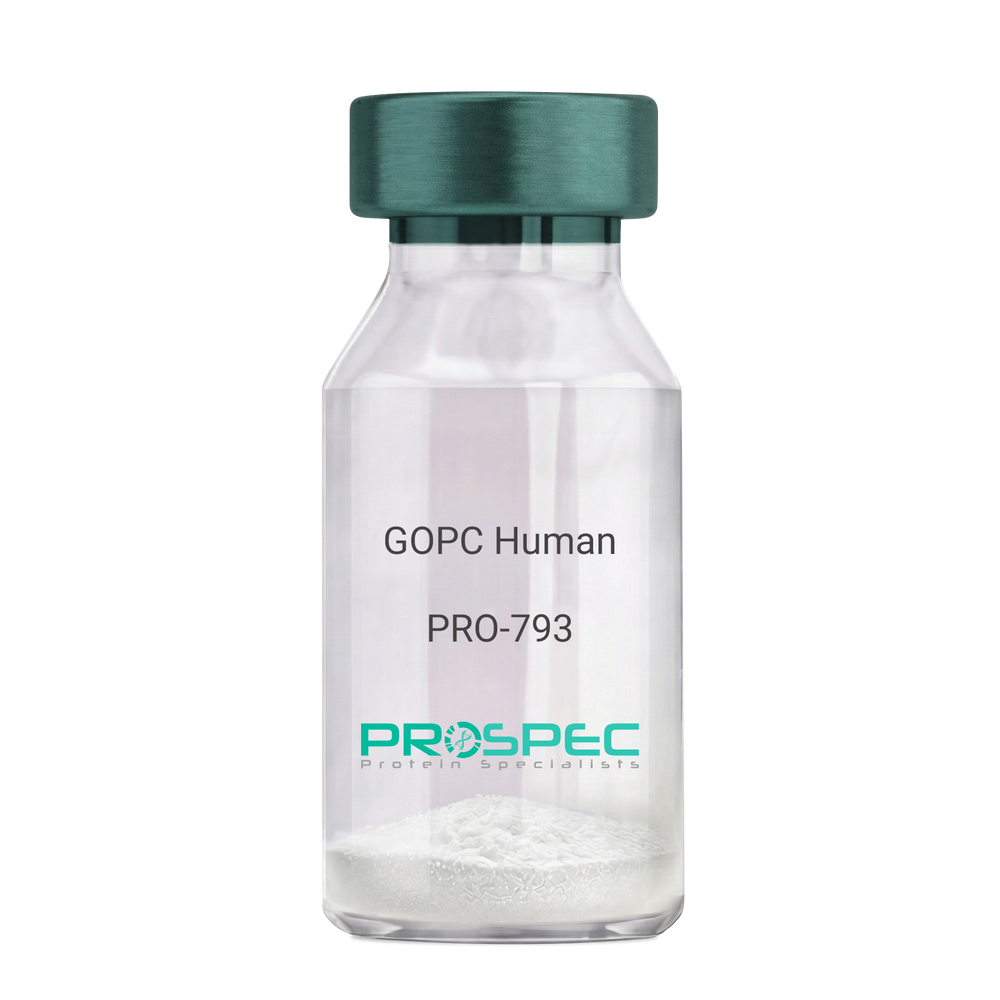
  • View Data Sheet

    Name :

    GOPC Human

    Description:

    Golgi-Associated PDZ and Coiled-Coil Motif Containing Human Recombinant

    CAL, dJ94G16.2, FIG, GOPC1, PIST, Golgi-associated PDZ and coiled-coil motif-containing protein, PDZ protein interacting specifically with TC10, CFTR-associated ligand, Fused in glioblastoma, GOPC.

    Product # :

    PRO-793

    Price :

    Quantity :

    Shipping Method :

    Ice Icon

    Shipped with Ice Packs

    Add To Cart

    More Info

    • description
    • source
    • formulation
    • purity
    • More Info
    • Citations

    Description

    GOPC Human Recombinant produced in E.Coli is a single, non-glycosylated polypeptide chain containing 198 amino acids (278-454 a.a.) and having a molecular mass of 21.5 kDa. The GOPC is fused to a 20 amino acid His Tag and purified by conventional chromatography.

    Source

    Escherichia Coli.

    Formulation

    The GOPC protein solution contains 20mM Tris-HCl pH-8, 1mM DTT and 10% glycerol.

    Purity

    Greater than 90.0% as determined by SDS-PAGE.

    Citations

    More Info

    • Introduction

      GOPC is a PDZ domain-containing Golgi protein which binds the extreme C terminus of proteins in a sequence-specific manner. GOPC participates in intracellular protein trafficking and degradation. GOPC regulates CFTR chloride currents and acid-induced ACCN3 currents by modulating cell surface expression of both channels. GOPC regulates the intracellular trafficking of the ADR1B receptor. GOPC takes part in autophagy. GOPC over expression results in CFTR intracellular retention and degradation in the lysosomes.

    • Synonyms

      CAL, dJ94G16.2, FIG, GOPC1, PIST, Golgi-associated PDZ and coiled-coil motif-containing protein, PDZ protein interacting specifically with TC10, CFTR-associated ligand, Fused in glioblastoma, GOPC.

    • Physical Appearance

      Sterile Filtered colorless solution.

    • Stability

      Store at 4°C if entire vial will be used within 2-4 weeks. Store, frozen at -20°C for longer periods of time. For long term storage it is recommended to add a carrier protein (0.1% HSA or BSA).Avoid multiple freeze-thaw cycles.

    • Amino Acid Sequence

      MGSSHHHHHH SSGLVPRGSH MIRKVLLLKE DHEGLGISIT GGKEHGVPIL ISEIHPGQPA DRCGGLHVGD AILAVNGVNL RDTKHKEAVT ILSQQRGEIE FEVVYVAPEV DSDDENVEYE DESGHRYRLY LDELEGGGNP GASCKDTSGE IKVLQGFNKK AVTDTHENGD LGTASETPLD DGASKLDDLH TLYHKKSY.

    ProSpec's products are furnished for LABORATORY RESEARCH USE ONLY. The product may not be used as drugs, agricultural or pesticidal products, food additives or household chemicals.

    Gopc Human
  • View Data Sheet

    Name :

    Norovirus Group-2 P-Domain

    Description:

    Norovirus Group-2 Capsid P-Domain Recombinant

    Product # :

    NRV-216

    Price :

    Quantity :

    Shipping Method :

    Ice Icon

    Shipped with Ice Packs

    Add To Cart

    More Info

    • description
    • source
    • formulation
    • purity
    • More Info
    • Citations

    Description

    The Recombinant Norovirus Group-2 Capsid P-Domain, E.Coli derived, VA387 Strain contains a.a. from 225-520 having a Mw of 30kDa. The protein is fused to a 6xHis tag at N-terminal and purified by chromatography techniques. P-domain (225-520 a.a.) forms P1- P2-P1 structure. P-domain has a receptor binding region to recognize human histo-blood group antigens (HBGAs). P-domain expressed in bacteria can spontaneously form a P dime and a P particle aggregated by 12 P dimmers. P-particle displays an enhanced binding activity to HBGAs higher than virus-like particle (VLP) formed by the full length capsid.

    Source

    Escherichia Coli.

    Formulation

    Phosphate buffer and 17mM K2CO3.

    Purity

    Protein is >95% pure as determined by 12% PAGE (coomassie staining).

    Citations

    More Info

    • Introduction

      Human norovirus is classified into two groups, group 1& group 2. Norwalk virus is the species which belongs to group 1 and was discovered in 1968 at Ohio. Norovirus is a familiar virus which causes human gastroenteritis with the following symptoms vomiting, diarrhea and sickness. CDC report revealed that there are 19-21 million Americans infected by Nororvirus annually with 800 deaths, 1 in 15 people with infection. Around the world, this virus affects about 267 million people and causes over 200,000 deaths each year; these losses are mostly in less developed countries and in the very young, elderly and immuno-suppressed population, though, most cases are self-limited with a full recovery within just a few days. Norovirus is extremely contagious and can spread from human to human through infected food, water or contaminated surfaces. The outbreaks usually occur from November-April, while the peak is in January. Norovirus is a positive sense RNA virus with 7.5 kb nucleotides, encoding a major structural protein VP1 with 50-55kDa. The full length of VP1 capsid comprises the internal N-terminal, Hinge, shell (S) and protruding (P) domains. P domain from 225 to 520 forms P1- P2-P1 structure. Moreover, P domain has a receptor binding region which recognizes human histo-blood group antigens (HBGAs). P domain expressed in bacteria can spontaneously form a P dime as well as a P particle aggregated by 12 P dimmers. P particle displays an increased binding activity to HBGAs higher than virus-like particle (VLP) formed by the full-length capsid. For norovirus vaccine development, we consider P domain as a good candidate.

    • Physical Appearance

      Sterile Filtered clear solution.

    • Stability

      The Recombinant Norovirus Group-2 P-Domain although stable at 4°C for 1 week, should be stored below -18°C. Please prevent freeze thaw cycles.

    ProSpec's products are furnished for LABORATORY RESEARCH USE ONLY. The product may not be used as drugs, agricultural or pesticidal products, food additives or household chemicals.

    Norovirus Group 2 P Domain
  • View Data Sheet

    Name :

    FNDC5 Human

    Description:

    Fibronectin Type III Domain Containing 5 Human Recombinant

    Fibronectin type III domain-containing protein 5, Fibronectin type III repeat-containing protein, Fibronectin Type III Repeat-Containing Protein 2, Irisin, FNDC5, FRCP2.

    Product # :

    PRO-1589

    Price :

    Quantity :

    Shipping Method :

    Room Temp Icon

    Shipped at Room temp

    Add To Cart

    More Info

    • description
    • source
    • formulation
    • purity
    • More Info
    • Citations

    Description

    FNDC5 Human Recombinant produced in E.Coli is a single, non-glycosylated, polypeptide chain (a.a 32-143) containing 122 amino acids including a 10 a.a N-terminal His tag. The total molecular mass is 13.8kDa (calculated).

    Source

    Escherichia Coli.

    Formulation

    FNDC5 filtered (0.4 µm) and lyophilized from 0.5mg/ml in phosphate buffered saline.

    Purity

    Greater than 95.0% as determined by SDS-PAGE.

    Citations

    More Info

    • Introduction

      Fibronectin Type III Domain Containing 5 (Irisin) is a newly discovered hormone, secreted into circulation by muscle, which acts on white adipocytes and promotes WAT “browning”. r-Irisin can reduce body weight and cause induction of brown adipocyte in vivo, including a capacity for thermogenic energy expenditure mediated by uncoupling protein 1 (UCP-1). Irisin mature protein is comprised of 110 amino acid residues and two potential glycosylation sites. High levels of Irisin can be found in the heart whereas Very low expression is found in the colon, pancreas and spleen, if any.

    • Synonyms

      Fibronectin type III domain-containing protein 5, Fibronectin type III repeat-containing protein, Fibronectin Type III Repeat-Containing Protein 2, Irisin, FNDC5, FRCP2.

    • Physical Appearance

      Filtered White lyophilized (freeze-dried) powder.

    • Stability

      Store lyophilized protein at -20°C. Aliquot the product after reconstitution to avoid repeated freezing/thawing cycles. Reconstituted protein can be stored at 4°C for a limited period of time; it does not show any change after two weeks at 4°C.

    • Solubility

      It is recommended to add deionized water to prepare a working stock solution of approximately 0.5mg/ml and let the lyophilized pellet dissolve completely. FNDC5 is not sterile! Please filter the product by an appropriate sterile filter before using it in the cell culture.

    • Amino Acid Sequence

      MKHHHHHHASDSPSAPVNVT VRHLKANSAV VSWDVLEDEV VIGFAISQQK KDVRMLRFIQ EVNTTTRSCA LWDLEEDTEY IVHVQAISIQ GQSPASEPVL FKTPREAEKM ASKNKDEVTM KE.

    ProSpec's products are furnished for LABORATORY RESEARCH USE ONLY. The product may not be used as drugs, agricultural or pesticidal products, food additives or household chemicals.

    Fndc5 Human
  • View Data Sheet

    Name :

    GIPC2 Antibody

    Description:

    GIPC PDZ Domain Member 2, Mouse Anti Human

    GIPC PDZ domain containing family member 2, SEMCAP-2, PDZ domain-containing protein GIPC2, semaphorin cytoplasmic domain associated protein 2, semaF cytoplasmic domain associated protein 2, SEMCAP2, FLJ20075.

    Product # :

    ANT-079

    Price :

    Quantity :

    Shipping Method :

    Ice Icon

    Shipped with Ice Packs

    Add To Cart

    More Info

    • formulation
    • More Info
    • Citations

    Formulation

    1mg/ml containing PBS, pH-7.4, & 0.1% Sodium Azide.

    Citations

    More Info

    • Introduction

      GIPC2 is a 315 aa protein which is restricted to the cytoplasm and holds one PDZ domain. GIPC2 is expressed in large quantities in colon and kidney and in small quantities in adult liver. GIPC2 has a vital part in human gastric cancer by control of growth factor signaling or cell adhesion.

    • Synonyms

      GIPC PDZ domain containing family member 2, SEMCAP-2, PDZ domain-containing protein GIPC2, semaphorin cytoplasmic domain associated protein 2, semaF cytoplasmic domain associated protein 2, SEMCAP2, FLJ20075.

    • Immunogen

      Anti-human GIPC2 mAb, is derived from hybridization of mouse FO myeloma cells with spleen cells from BALB/c mice immunized with recombinant human GIPC2 amino acids 1-315 purified from E. coli.

    • Ig Subclass

      Mouse IgG1 heavy chain and κ light chain.

    • Clone

      PAT1G10AT.

    • Applications

      GIPC2 antibody has been tested by ELISA, Western blot analysis to assure specificity and reactivity. Since application varies, however, each investigation should be titrated by the reagent to obtain optimal results. Recommended dilution range for Western blot analysis is 1:1000.

    • Type

      Mouse Anti Human Monoclonal.

    • Storage Procedures

      For periods up to 1 month store at 4°C, for longer periods of time, store at -20°C. Prevent freeze thaw cycles.

    • Purification Method

      GIPC2 antibody was purified from mouse ascitic fluids by protein-G affinity chromatography.

    ProSpec's products are furnished for LABORATORY RESEARCH USE ONLY. The product may not be used as drugs, agricultural or pesticidal products, food additives or household chemicals.

    Gipc2 Antibody
  • View Data Sheet

    Name :

    Norovirus Group-1 P-Domain

    Description:

    Norovirus Group-1 Capsid P-Domain Recombinant

    Product # :

    NRV-215

    Price :

    Quantity :

    Shipping Method :

    Ice Icon

    Shipped with Ice Packs

    Add To Cart

    More Info

    • description
    • source
    • formulation
    • purity
    • More Info
    • Citations

    Description

    The Recombinant Norovirus Group-1 Capsid P-Domain, E.Coli derived, Norwalk strain contains a.a. from 225-520 having a Mw of 30kDa. The protein is fused to a 6xHis tag at N-terminal and purified by chromatography techniques. P-domain (225-520 a.a.) forms P1- P2-P1 structure. P-domain has a receptor binding region to recognize human histo-blood group antigens (HBGAs). P-domain expressed in bacteria can spontaneously form a P dime and a P particle aggregated by 12 P dimmers. P-particle displays an enhanced binding activity to HBGAs higher than virus-like particle (VLP) formed by the full length capsid.

    Source

    Escherichia Coli.

    Formulation

    Phosphate buffer and 10 mM K2CO3.

    Purity

    Protein is >95% pure as determined by 12% PAGE (coomassie staining).

    Citations

    More Info

    • Introduction

      Human norovirus is classified into two groups, group 1& group 2. Norwalk virus is the species which belongs to group 1 and was discovered in 1968 at Ohio. Norovirus is a familiar virus which causes human gastroenteritis with the following symptoms vomiting, diarrhea and sickness. CDC report revealed that there are 19-21 million Americans infected by Nororvirus annually with 800 deaths, 1 in 15 people with infection. Around the world, this virus affects about 267 million people and causes over 200,000 deaths each year; these losses are mostly in less developed countries and in the very young, elderly and immuno-suppressed population, though, most cases are self-limited with a full recovery within just a few days. Norovirus is extremely contagious and can spread from human to human through infected food, water or contaminated surfaces. The outbreaks usually occur from November-April, while the peak is in January. Norovirus is a positive sense RNA virus with 7.5 kb nucleotides, encoding a major structural protein VP1 with 50-55kDa. The full length of VP1 capsid comprises the internal N-terminal, Hinge, shell (S) and protruding (P) domains. P domain from 225 to 520 forms P1- P2-P1 structure. Moreover, P domain has a receptor binding region which recognizes human histo-blood group antigens (HBGAs). P domain expressed in bacteria can spontaneously form a P dime as well as a P particle aggregated by 12 P dimmers. P particle displays an increased binding activity to HBGAs higher than virus-like particle (VLP) formed by the full-length capsid. For norovirus vaccine development, we consider P domain as a good candidate.

    • Physical Appearance

      Sterile Filtered clear solution.

    • Stability

      The Recombinant Norovirus Group-1 P-Domain although stable at 4°C for 1 week, should be stored below -18°C. Please prevent freeze thaw cycles.

    ProSpec's products are furnished for LABORATORY RESEARCH USE ONLY. The product may not be used as drugs, agricultural or pesticidal products, food additives or household chemicals.

    Norovirus Group 1 P Domain
  • View Data Sheet

    Name :

    BID Human

    Description:

    BH3 Interacting Domain Death Agonist Human Recombinant

    BH3-interacting domain death agonist, p22 BID, BID, FP497, MGC15319, MGC42355.

    Product # :

    PRO-627

    Price :

    Quantity :

    Shipping Method :

    Ice Icon

    Shipped with Ice Packs

    Add To Cart

    More Info

    • description
    • source
    • formulation
    • purity
    • More Info
    • Citations

    Description

    BID Human Recombinant produced in E.Coli is a single, non-glycosylated polypeptide chain containing 195 amino acids and having a molecular mass of 21.9 kDa.

    Source

    Escherichia Coli.

    Formulation

    The protein solution contains 20mM Tris-HCl pH-8 & 20% NaCl.

    Purity

    Greater than 95.0% as determined by:
    (a) Analysis by RP-HPLC.
    (b) Analysis by SDS-PAGE.

    Citations

    More Info

    • Introduction

      BID accession number NP_001187 is a pro-apoptotic Bcl-2 protein having only the BH3 domain. In reaction to apoptotic signaling, BID interacts with another Bcl-2 family of cell death regulators, called Bax, they form a heterodimer resulting to the insertion of Bax into the outer mitochondrial membrane. Bax induces the opening of the mitochondrial voltage-dependent anion channel which lead to the release of cytochrome c and other pro-apoptotic factors from the mitochondria resulting in activation of caspases. BID is a mediator of mitochondrial damage induced by caspase-8 (CASP8). CASP8 cleaves BID, and the COOH-terminal part translocates to mitochondria where it triggers cytochrome c release. The major proteolytic product p15 BID releasea cytochrome c. Isoform 1, Isoform 2 and Isoform 4 induce ice-like proteases and apoptosis while Isoform 3 does not induce apoptosis.

    • Synonyms

      BH3-interacting domain death agonist, p22 BID, BID, FP497, MGC15319, MGC42355.

    • Physical Appearance

      Sterile Filtered colorless solution.

    • Stability

      Store at 4°C if entire vial will be used within 2-4 weeks. Store, frozen at -20°C for longer periods of time. For long term storage it is recommended to add a carrier protein (0.1% HSA or BSA).Avoid multiple freeze-thaw cycles.

    • Amino Acid Sequence

      MDCEVNNGSS LRDECITNLL VFGFLQSCSD NSFRRELDAL GHELPVLAPQ WEGYDELQTD GNRSSHSRLG RIEADSESQE
      DIIRNIARHL AQVGDSMDRS IPPGLVNGLA LQLRNTSRSE EDRNRDLATA LEQLLQAYPR DMEKEKTMLV LALLLAKKVA SHTPSLLRDV FHTTVNFINQ NLRTYVRSLA RNGMD.

    ProSpec's products are furnished for LABORATORY RESEARCH USE ONLY. The product may not be used as drugs, agricultural or pesticidal products, food additives or household chemicals.

    Bid Human
  • View Data Sheet

    Name :

    C3d Human

    Description:

    Complement C3d Human

    Complement C3, C3 and PZP-like alpha-2-macroglobulin domain-containing protein 1, C3, CPAMD1.

    Product # :

    PRO-2687

    Price :

    Quantity :

    Shipping Method :

    Ice Icon

    Shipped with Ice Packs

    Add To Cart

    More Info

    • description
    • source
    • formulation
    • purity
    • More Info
    • Citations

    Description

    Human Complement C3d produced in Human plasma having a molecular mass of 33.8kDa.

    Source

    Human Plasma.

    Formulation

    C3d solution contains phosphate buffered saline, pH 7.2.

    Purity

    Greater than 95.0% as determined by SDS-PAGE.

    Citations

    More Info

    • Introduction

      C3d is derived from human C3 after a series of proteolytic cleavages.C3d is prepared from purified human C3. The C3 is converted to C3b by treatment with the natural human C3 convertase and this C3b is converted to iC3b. Finally, this iC3b is cleaved with trypsin to yield C3d.If the C3b precursor was attached to a surface (as occurs during complement activation) the iC3b, C3dg and C3d fragments would remain covalently attached to that surface.C3d is able to attach to a surfaceonly during complement activation on a surface. Surface-bound C3d is linked to the target through an ester or an amide covalent bond. Ester bonds are unstable, thusC3d releasesfrom the particle.

    • Synonyms

      Complement C3, C3 and PZP-like alpha-2-macroglobulin domain-containing protein 1, C3, CPAMD1.

    • Physical Appearance

      Sterile filtered solution.

    • Stability

      C3d Human is stable at 4°C if entire vial will be used within 2-4 weeks.Store, frozen below -20°C for longer periods of time.For long term storage it is recommended to add a carrier protein (0.1% HSA or BSA).Avoid multiple freeze-thaw cycles.

    • Human Virus Test

      Plasma from each donor has been tested and found negative for antibody to HIV-1, HIV-2, HCV and HBSAG.

    ProSpec's products are furnished for LABORATORY RESEARCH USE ONLY. The product may not be used as drugs, agricultural or pesticidal products, food additives or household chemicals.

    C3D Human
  • View Data Sheet

    Name :

    DnaK SBD

    Description:

    DnaK Substrate Binding Domain E.Coli Recombinant

    HSP-70, HSP70, DnaK, Chaperone protein dnaK, Heat shock protein 70, Heat shock 70 kDa protein, groP, grpF, seg, b0014, JW0013.

    Product # :

    HSP-008

    Price :

    Quantity :

    Shipping Method :

    Ice Icon

    Shipped with Ice Packs

    Add To Cart

    More Info

    • description
    • source
    • formulation
    • purity
    • More Info
    • Citations

    Description

    Recombinant DnaK Substrate Binding domain produced in E.Coli is a single, non-glycosylated polypeptide chain containing (385-546 a.a.) 163 amino acids and having a molecular mass of 17.7 kDa.

    Source

    Escherichia Coli.

    Formulation

    The protein contains 25mM Tris-HCl, pH7.5, 2mM B-ME and 1mM DTT.

    Purity

    Greater than 95.0% as determined by SDS-PAGE.

    Citations

    More Info

    • Introduction

      DnaK, originally identified for its DNA replication by bacteriophage l in E. coli is the bacterial hsp70 chaperone. This protein is involved in the folding and assembly of newly synthesized polypeptide chains and in preventing the aggregation of stress-denatured proteins. Dnak(residues 508-638) of the substrate binding domain is a-helical and appears to act as a lid covering the substrate binding cleft. DnaK(amino acid 508-638) was purified to apparent homogeneity by using conventional column chromatography techniques. Additional amino acid (Met) is attached at N- terminus.

    • Synonyms

      HSP-70, HSP70, DnaK, Chaperone protein dnaK, Heat shock protein 70, Heat shock 70 kDa protein, groP, grpF, seg, b0014, JW0013.

    • Physical Appearance

      Sterile filtered colorless solution.

    • Stability

      Store at 4°C if entire vial will be used within 2-4 weeks. Store, frozen at -20°C for longer periods of time. For long term storage it is recommended to add a carrier protein (0.1% HSA or BSA).Avoid multiple freeze-thaw cycles.

    • Amino Acid Sequence

      MDVKDVLLLD VTPLSLGIET MGGVMTTLIA KNTTIPTKHS QVFSTAEDNQ SAVTIHVLQG ERKRAADNKS LGQFNLDGIN PAPRGMPQIE VTFDIDADGI LHVSAKDKNS GKEQKITIKA SSGLNEDEIQ KMVRDAEANA EADRKFEELV QTRNQGDHLL HST.

    ProSpec's products are furnished for LABORATORY RESEARCH USE ONLY. The product may not be used as drugs, agricultural or pesticidal products, food additives or household chemicals.

    Dnak Sbd
  • View Data Sheet

    Name :

    PDX-1 antibody

    Description:

    Pancreas Duodenum Homeobox-1, Polyclonal Rabbit Antibody

    IPF1, IUF1, IDX-1, MODY4, PDX1, STF-1, Insulin promoter factor 1, Pancreas Duodenum Homeobox-1.

    Product # :

    ANT-162

    Price :

    Quantity :

    Shipping Method :

    Room Temp Icon

    Shipped at Room temp

    Add To Cart

    More Info

    • More Info
    • Citations

    Citations

    More Info

    • Introduction

      PDX1 activates insulin, somatostatin, glucokinase, islet amyloid polypeptide and glucose transporter type 2 gene transcription. IPF1 is particularly involved in glucose-dependent regulation of insulin gene transcription. Pancreas Duodenum Homeobox-1 binds preferentially the DNA motif 5'-[ct]taat[tg]-3'. During development, specifies the early pancreatic epithelium, permitting its proliferation, branching and subsequent differentiation. At adult stage, it is required for maintaining the hormone-producing phenotype of the beta-cell.

    • Synonyms

      IPF1, IUF1, IDX-1, MODY4, PDX1, STF-1, Insulin promoter factor 1, Pancreas Duodenum Homeobox-1.

    • Stability

      Stable for 2 yeas at -20°C. Avoid freeze/thaw cycles.

    • Immunogen

      Recombinant PDX1 E.Coli derived.

    • Applications

      Western Blot: 1:1,000
      Immunohistochemistry: 1:500
      Optimal working dilutions must be determined by end user.
      Routinely evaluated by western blot on lysates of rat pancreatic cell line INS-1

    • Molecular Weight

      35-40 kDa.

    • Specificity

      Human and Mouse PDX-1.

    • Type

      Polyclonal Rabbit Antibody.

    ProSpec's products are furnished for LABORATORY RESEARCH USE ONLY. The product may not be used as drugs, agricultural or pesticidal products, food additives or household chemicals.

    Pdx 1 Antibody
  • View Data Sheet

    Name :

    Zika Envelope Domain-3

    Description:

    Zika Envelope Domain-III Recombinant

    Product # :

    ZKV-008

    Price :

    Quantity :

    Shipping Method :

    Room Temp Icon

    Shipped at Room temp

    Add To Cart

    More Info

    • description
    • source
    • formulation
    • purity
    • More Info
    • Citations

    Description

    The E.Coli derived Zika Envelope domain-III is a non-glycosylated polypeptide chain having a molecular mass of 11 kDa and fused to a His tag at N-terminus.

    Source

    Escherichia Coli.

    Formulation

    Lyophilized from 1mg/ml in 20mM sodium carbonate pH-10.

    Purity

    Greater than 95.0% as determined by SDS-PAGE.

    Citations

    More Info

    • Introduction

      Zika virus (ZIKV) belongs to the family Flaviviridae and the genus Flavivirus, it is transmitted by daytime-active Aedes mosquitoes, such as A. aegypti and A. albopictus. The Zika virus is related to the dengue, yellow fever, Japanese encephalitis, and West Nile viruses. Much like the other flaviviruses, Zika virus is enveloped and icosahedral and has a nonsegmented, single-stranded, positive-sense RNA genome. Zika fever is an infection, which often causes no symptoms or only mild ones, like a mild form of dengue fever, and it is treated by rest. As of February 2016, there has been mounting evidence that Zika fever in pregnant women can cause abnormal brain development in their fetuses by mother-to-child transmission, which may result in miscarriage or microcephaly, however it is not yet known whether Zika virus causes microcephaly. Furthermore, a connection has been established with neurologic conditions in infected adults, including Guillain–Barre syndrome.

    • Physical Appearance

      Sterile Filtered White lyophilized (freeze-dried) powder.

    • Stability

      Store the lyophilized Zika Envelope between 2-8°C, do not freeze. Upon reconstitution Zika Envelope should be stored at 4°C for 6 months and for future use below -18°C. Please prevent freeze-thaw cycles.

    • Solubility

      It is recommended to reconstitute the lyophilized Zika Envelope Domain-3 protein in sterile 18M-cm H2O at 1mg/ml, which can then be further diluted to other aqueous solutions.

    ProSpec's products are furnished for LABORATORY RESEARCH USE ONLY. The product may not be used as drugs, agricultural or pesticidal products, food additives or household chemicals.

    Zika Envelope Domain 3
  • 1
  • 2
  • 3
  • …
  • 12
Your browser does not support the video tag.

Products

  • Cytokines
  • Growth Factors
  • Chemokines
  • CD Antigens
  • Neurotrophins
  • Hormones
  • Enzymes
  • Viral Antigens
  • Recombinant Proteins
  • Natural Proteins
  • Monoclonal Antibodies
  • Polyclonal Antibodies
  • Thermal Packaging

About

  • Company
  • Founder
  • Contribution
  • Contact Us
  • My Account

Ordering

  • Ordering Method
  • Ordering - Credit Card
  • Ordering PO
  • Shipping Fees
  • FAQ's

Legal

  • Terms & Conditions
  • Privacy
  • Site Map
  • info@prospecbio.com
  • Facebook
  • Instagram
  • Linkedin Profile

© 2026 ProSpec-Tany TechnoGene Ltd. All Rights Reserved.

  • Choosing a selection results in a full page refresh.
  • Opens in a new window.