Search results
1000 results found for “GRO (CXCL1,2,3)”
Name
Description
Product #
Price
Quantity
Shipping Method
- View Data Sheet
Name :
GRO g MouseDescription:
GRO-Gamma Mouse Recombinant (CXCL3)
C-X-C motif chemokine 3, Dendritic cell inflammatory protein 1, Cxcl3, Dcip1, Gm1960.
Product # :
CHM-255Price :
Quantity :
Shipping Method :
Shipped at Room temp
More Info
- description
- source
- formulation
- purity
- biological activity
- More Info
Description
GRO-g Mouse Recombinant produced in E.Coli is a single,non-glycosylated, polypeptide chain containing 69 amino acids and having a molecular mass of 7.7kDa. The CXCL3 is purified by proprietary chromatographic techniques.
Source
Escherichia Coli.
Formulation
The Mouse CXCL3 lyophilized from a 0.2µm filtered concentrated solution in 1×PBS, pH 7.4.
Purity
Greater than 97.0% as determined by:
(a) Analysis by RP-HPLC.
(b) Analysis by SDS-PAGE.Biological Activity
Determined by its ability to chemoattract 293 transfected CXCR2 cells using a concentration range of 10-100 ng/ml, corresponding to a specific activity of 10,000-100,000 units/mg.More Info
-
Introduction
Chemokine (C-X-C motif) ligand 3 (CXCL3) is a small cytokine belonging to the CXC chemokine family that is also known as GRO3 oncogene (GRO3), GRO protein gamma (GROg) and macrophage inflammatory protein-2-beta (MIP2b). CXCL3 controls migration and adhesion of monocytes and mediates it effects on its target cell by interacting with a cell surface chemokine receptor called CXCR2. The gene for CXCL3 is located on chromosome 4 in a cluster of other CXC chemokines.
-
Synonyms
C-X-C motif chemokine 3, Dendritic cell inflammatory protein 1, Cxcl3, Dcip1, Gm1960.
-
Physical Appearance
Sterile Filtered White lyophilized (freeze-dried) powder.
-
Stability
Lyophilized GRO-gamma although stable at room temperature for 3 weeks, should be stored desiccated below -18°C. Upon reconstitution CXCL3 should be stored at 4°C between 2-7 days and for future use below -18°C.For long term storage it is recommended to add a carrier protein (0.1% HSA or BSA).Please prevent freeze-thaw cycles.
-
Solubility
It is recommended to reconstitute the lyophilized GRO-gamma in sterile 18M-cm H2O not less than 100µg/ml, which can then be further diluted to other aqueous solutions.
-
Amino Acid Sequence
SELRCQCLNT LPRVDFETIQ SLTVTPPGPH CTQTEVIATL KDGQEVCLNP QGPRLQIIIK KILKSGKSS.
ProSpec's products are furnished for LABORATORY RESEARCH USE ONLY. The product may not be used as drugs, agricultural or pesticidal products, food additives or household chemicals.
- View Data Sheet
Name :
GRO g/CINC-2a RatDescription:
GRO-Gamma Rat Recombinant (CXCL3), CINC-2 alpha
Cytokine-induced neutrophil chemoattractant 2, CINC2, CINC-2, Macrophage inflammatory protein 2-alpha.
Product # :
CHM-258Price :
Quantity :
Shipping Method :
Shipped at Room temp
More Info
- description
- source
- formulation
- purity
- biological activity
- More Info
Description
GRO-g Rat Recombinant produced in E.Coli is a single,non-glycosylated, polypeptide chain containing 69 amino acids and having a molecular mass of 7.8kDa. The CXCL3 is purified by proprietary chromatographic techniques.
Source
Escherichia Coli.
Formulation
The Rat CXCL3 lyophilized from a 0.2µm filtered concentrated solution in 1×PBS, pH 7.4.
Purity
Greater than 98.0% as determined by:
(a) Analysis by RP-HPLC.
(b) Analysis by SDS-PAGE.Biological Activity
Determined by its ability to chemoattract 293 transfected CXCR2 cells using a concentration range of 10-100 ng/ml, corresponding to a specific activity of 10,000-100,000 units/mg.More Info
-
Introduction
Chemokine (C-X-C motif) ligand 3 (CXCL3) is a small cytokine belonging to the CXC chemokine family that is also known as GRO3 oncogene (GRO3), GRO protein gamma (GROg) and macrophage inflammatory protein-2-beta (MIP2b). CXCL3 controls migration and adhesion of monocytes and mediates it effects on its target cell by interacting with a cell surface chemokine receptor called CXCR2. The gene for CXCL3 is located on chromosome 4 in a cluster of other CXC chemokines.
-
Synonyms
Cytokine-induced neutrophil chemoattractant 2, CINC2, CINC-2, Macrophage inflammatory protein 2-alpha.
-
Physical Appearance
Sterile Filtered White lyophilized (freeze-dried) powder.
-
Stability
Lyophilized GRO-gamma although stable at room temperature for 3 weeks, should be stored desiccated below -18°C. Upon reconstitution CXCL3 should be stored at 4°C between 2-7 days and for future use below -18°C.For long term storage it is recommended to add a carrier protein (0.1% HSA or BSA).Please prevent freeze-thaw cycles.
-
Solubility
It is recommended to reconstitute the lyophilized GRO-gamma in sterile 18Mcm H2O not less than 100µg/ml, which can then be further diluted to other aqueous solutions.
-
Amino Acid Sequence
RELRCQCLKT LPRVDFENIQ SLTVTPPGPH CTQTEVIATL KDGQEVCLNP QAPRLQKIIQ KLLKSDKSS.
ProSpec's products are furnished for LABORATORY RESEARCH USE ONLY. The product may not be used as drugs, agricultural or pesticidal products, food additives or household chemicals.
- View Data Sheet
Name :
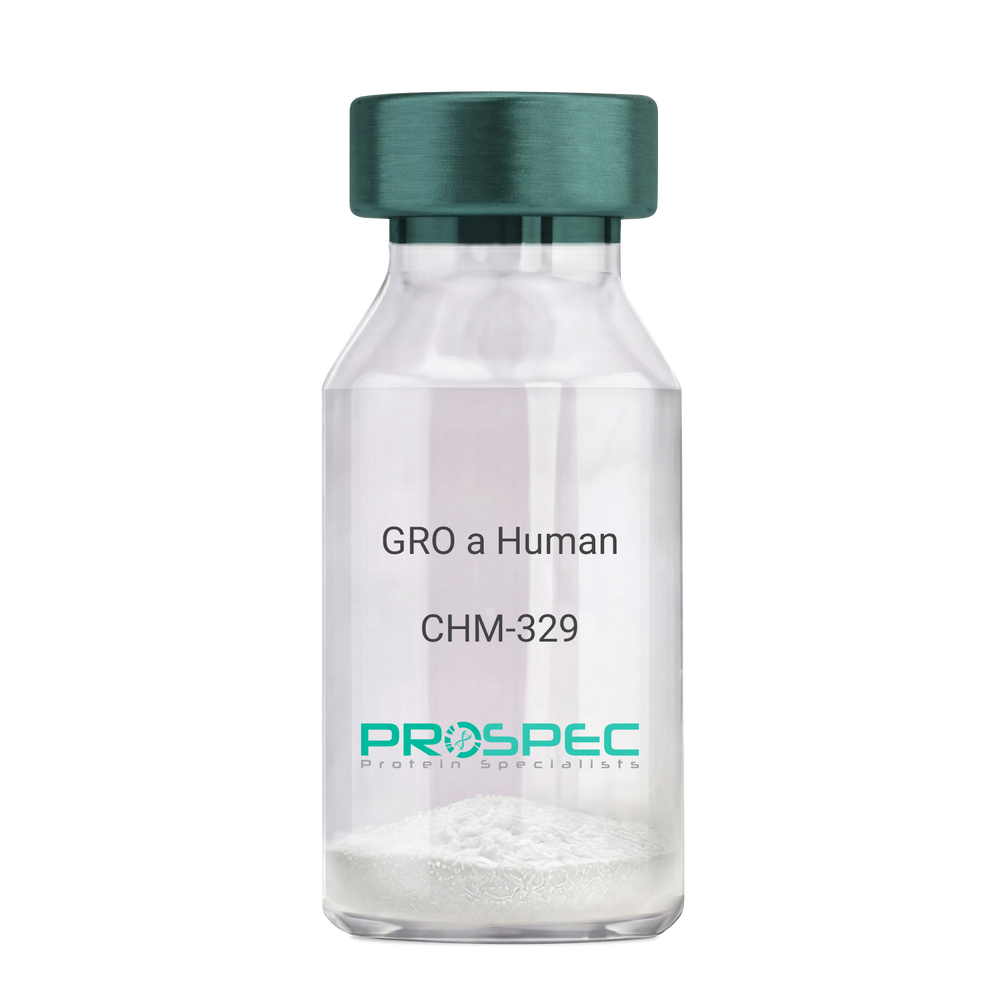
GRO a HumanDescription:
GRO-Alpha Human Recombinant (CXCL1)
Growth-regulated protein alpha, CXCL1, Melanoma growth stimulatory activity, MGSA, Neutrophil-activating protein 3, NAP-3, GRO-alpha (1-73), chemokine (C-X-C motif) ligand 1, GRO1, GROa, SCYB1, MGSA-a, MGSA alpha.
Product # :
CHM-329Price :
Quantity :
Shipping Method :
Shipped at Room temp
More Info
- description
- source
- formulation
- purity
- biological activity
- More Info
Description
GRO Alpha Human Recombinant produced in E.Coli is a single,non-glycosylated, polypeptide chain containing 73 amino acids and having a molecular mass of 7811 Dalton. The GRO-alpha is purified by proprietary chromatographic techniques.
Source
Escherichia Coli.
Formulation
Lyophilized from a 0.2µm filtered concentrated (1mg/ml) solution in 20mM PB, pH 7.4, 50mM NaCl.
Purity
Greater than 97.0% as determined by:
(a) Analysis by RP-HPLC.
(b) Analysis by SDS-PAGE.Biological Activity
Determined by its ability to chemoattract human peripheral blood neutrophils using a concentration range of 10.0-100.0 ng/ml.
More Info
-
Introduction
Chemokine (C-X-C motif) ligand 1 (CXCL1) is a small cytokine belonging to the CXC chemokine family that was previously called GRO1 oncogene, Neutrophil-activating protein 3 (NAP-3) and melanoma growth stimulating activity, alpha (MSGA-a). It is secreted by human melanoma cells, has mitogenic properties and is implicated in melanoma pathogenesis. CXCL1 is expressed by macrophages, neutrophilsand epithelial cells, and has neutrophil chemoattractant activity. CXCL1 plays a role in spinal cord development by inhibiting the migration of oligodendrocyte precursors and is involved in the processes of angiogenesis, inflammation, wound healing, and tumorigenesis. This chemokine elicits its effects by signaling through the chemokine receptor CXCR2. The gene for CXCL1 is located on human chromosome 4 amongst genes for other CXC chemokines.
-
Synonyms
Growth-regulated protein alpha, CXCL1, Melanoma growth stimulatory activity, MGSA, Neutrophil-activating protein 3, NAP-3, GRO-alpha (1-73), chemokine (C-X-C motif) ligand 1, GRO1, GROa, SCYB1, MGSA-a, MGSA alpha.
-
Physical Appearance
Sterile Filtered White lyophilized (freeze-dried) powder.
-
Stability
Lyophilized GRO-alpha although stable at room temperature for 3 weeks, should be stored desiccated below -18°C. Upon reconstitution CXCL1 should be stored at 4°C between 2-7 days and for future use below -18°C. For long term storage it is recommended to add a carrier protein (0.1% HSA or BSA).Please prevent freeze-thaw cycles.
-
Solubility
It is recommended to reconstitute the lyophilized CXCL1 in sterile 18MΩ-cm H2O not less than 100µg/ml, which can then be further diluted to other aqueous solutions.
-
Amino Acid Sequence
The sequence of the first five N-terminal amino acids was determined and was found to be Ala-Ser-Val-Ala-Thr.
ProSpec's products are furnished for LABORATORY RESEARCH USE ONLY. The product may not be used as drugs, agricultural or pesticidal products, food additives or household chemicals.
- View Data Sheet
Name :
GRO g HumanDescription:
GRO-Gamma Human Recombinant (CXCL3)
Macrophage inflammatory protein 2-beta, MIP2-beta, CXCL3, Growth-regulated protein gamma, GRO-gamma, GRO-gamma(1-73), GRO3, GROg, MIP2B, SCYB3, MIP-2b, CINC-2b, MGSA gamma.
Product # :
CHM-310Price :
Quantity :
Shipping Method :
Shipped at Room temp
More Info
- description
- source
- formulation
- purity
- biological activity
- More Info
Description
GRO-Gamma Human Recombinant produced in E.Coli is a single, non-glycosylated, polypeptide chain containing 73 amino acids and having a molecular mass of 7902 Dalton. The CXCL3 is purified by proprietary chromatographic techniques.
Source
Escherichia Coli.
Formulation
The protein was lyophilized with no additives.
Purity
Greater than 98.0% as determined by:
(a) Analysis by RP-HPLC.
(b) Analysis by SDS-PAGE.Biological Activity
The Biological activity is calculated by its ability to chemoattract CXCR2 transfected 293 cells using 10-100ng/ml corresponding to a Specific Activity of 10,000-100,000IU/mg.More Info
-
Introduction
Chemokine (C-X-C motif) ligand 3 (CXCL3) is a small cytokine belonging to the CXC chemokine family that is also known as GRO3 oncogene (GRO3), GRO protein gamma (GROg) and macrophage inflammatory protein-2-beta (MIP2b). CXCL3 controls migration and adhesion of monocytes and mediates it effects on its target cell by interacting with a cell surface chemokine receptor called CXCR2. The gene for CXCL3 is located on chromosome 4 in a cluster of other CXC chemokines.
-
Synonyms
Macrophage inflammatory protein 2-beta, MIP2-beta, CXCL3, Growth-regulated protein gamma, GRO-gamma, GRO-gamma(1-73), GRO3, GROg, MIP2B, SCYB3, MIP-2b, CINC-2b, MGSA gamma.
-
Physical Appearance
Sterile Filtered White lyophilized (freeze-dried) powder.
-
Stability
Lyophilized GRO-gamma although stable at room temperature for 3 weeks, should be stored desiccated below -18°C. Upon reconstitution CXCL3 should be stored at 4°C between 2-7 days and for future use below -18°C. For long term storage it is recommended to add a carrier protein (0.1% HSA or BSA).Please prevent freeze-thaw cycles.
-
Solubility
It is recommended to reconstitute the lyophilized CXCL3 in sterile 18MΩ-cm H2O not less than 100µg/ml, which can then be further diluted to other aqueous solutions.
-
Amino Acid Sequence
The sequence of the first five N-terminal amino acids was determined and was found to be Ala-Ser-Val-Val-Thr.
ProSpec's products are furnished for LABORATORY RESEARCH USE ONLY. The product may not be used as drugs, agricultural or pesticidal products, food additives or household chemicals.
- View Data Sheet
Name :
GRO a RatDescription:
GRO-Alpha Rat Recombinant (CXCL1)
Growth-regulated protein alpha, CXCL1, Melanoma growth stimulatory activity, MGSA, Neutrophil-activating protein 3, NAP-3, GRO-alpha(1-73), chemokine (C-X-C motif) ligand 1, GRO1, GROa, SCYB1, MGSA-a, MGSA alpha.
Product # :
CHM-375Price :
Quantity :
Shipping Method :
Shipped at Room temp
More Info
- description
- source
- formulation
- purity
- biological activity
- More Info
Description
CXCL1 Rat Recombinant produced in E.Coli is a single,non-glycosylated, polypeptide chain containing 73 amino acids and having a molecular mass of 7.8 kDa. The Rat CXCL1 is purified by proprietary chromatographic techniques.
Source
Escherichia Coli.
Formulation
Lyophilized from a 0.2μm filtered concentrated (1mg/ml) solution in 20mM PB, pH 7.4, and 150mM NaCl.
Purity
Greater than 97.0% as determined by:
(a) Analysis by RP-HPLC.
(b) Analysis by SDS-PAGE.Biological Activity
Determined by its ability to chemoattract rat neutrophils using a concentration range of 10-100ng/ml corresponding to a Specific Activity of 10,000-100,000IU/mg.More Info
-
Introduction
Chemokine (C-X-C motif) ligand 1 (CXCL1) is a small cytokine belonging to the CXC chemokine family that was previously called GRO1 oncogene, Neutrophil-activating protein 3 (NAP-3) and melanoma growth stimulating activity, alpha (MSGA-α). It is secreted by human melanoma cells, has mitogenic properties and is implicated in melanoma pathogenesis. CXCL1 is expressed by macrophages, neutrophils and epithelial cells, and has neutrophil chemoattractant activity. CXCL1 plays a role in spinal cord development by inhibiting the migration of oligodendrocyte precursors and is involved in the processes of angiogenesis, inflammation, wound healing, and tumorigenesis. This chemokine elicits its effects by signaling through the chemokine receptor CXCR2. The gene for CXCL1 is located on human chromosome 4 amongst genes for other CXC chemokines.
-
Synonyms
Growth-regulated protein alpha, CXCL1, Melanoma growth stimulatory activity, MGSA, Neutrophil-activating protein 3, NAP-3, GRO-alpha(1-73), chemokine (C-X-C motif) ligand 1, GRO1, GROa, SCYB1, MGSA-a, MGSA alpha.
-
Physical Appearance
Sterile Filtered White lyophilized (freeze-dried) powder.
-
Stability
Lyophilized CXCL1 although stable at room temperature for 3 weeks, should be stored desiccated below -18°C. Upon reconstitution CXCL1 should be stored at 4°C between 2-7 days and for future use below -18°C.For long term storage it is recommended to add a carrier protein (0.1% HSA or BSA).Please prevent freeze-thaw cycles.
-
Solubility
It is recommended to reconstitute the lyophilized CXCL1 in sterile 18MΩ-cm H2O not less than 100µg/ml, which can then be further diluted to other aqueous solutions.
-
Amino Acid Sequence
APVANELRCQ CLQTVAGIHF KNIQSLKVMP PGPHCTQTEV IATLKNGREA CLDPEAPMVQ KIVQKMLKGV PK.
ProSpec's products are furnished for LABORATORY RESEARCH USE ONLY. The product may not be used as drugs, agricultural or pesticidal products, food additives or household chemicals.
- View Data Sheet
Name :
GRO b HumanDescription:
GRO-Beta Human Recombinant (CXCL2)
Macrophage inflammatory protein 2-alpha, MIP2-alpha, CXCL2, Growth- regulated protein beta, Gro-beta, chemokine (C-X-C motif) ligand 2, GRO2, GROb, MIP2, MIP2A, SCYB2, MGSA-b, MIP-2a, CINC-2a, MGSA beta.
Product # :
CHM-309Price :
Quantity :
Shipping Method :
Shipped at Room temp
More Info
- description
- source
- formulation
- purity
- biological activity
- More Info
Description
GRO-Beta Human Recombinant produced in E.Coli is a single,non-glycosylated, polypeptide chain containing 73 amino acids and having a molecular mass of 7908 Dalton. The CXCL2 is purified by proprietary chromatographic techniques.
Source
Escherichia Coli.
Formulation
The protein was lyophilized with no additives.
Purity
Greater than 98.0% as determined by:
(a) Analysis by RP-HPLC.
(b) Analysis by SDS-PAGE.Biological Activity
The Biological activity is calculated by its ability to chemoattract CXCR2 transfected 293 cells using 10-100ng/ml corresponding to a Specific Activity of 10,000-100,000IU/mg.More Info
-
Introduction
Chemokine (C-X-C motif) ligand 2 (CXCL2) is a small cytokine belonging to the CXC chemokine family that is also called macrophage inflammatory protein 2-alpha (MIP2-alpha), Growth-regulated protein beta (Gro-beta) and Gro oncogene-2 (Gro-2). CXCL2 is 90% identical in amino acid sequence as a related chemokine, CXCL1. This chemokine is secreted by monocytes and macrophages and is chemotactic for polymorphonuclear leukocytes and hematopoietic stem cells. The gene for CXCL2 is located on human chromosome 4 in a cluster of other CXC chemokines. CXCL2 mobilizes cells by interacting with a cell surface chemokine receptor called CXCR2.
-
Synonyms
Macrophage inflammatory protein 2-alpha, MIP2-alpha, CXCL2, Growth- regulated protein beta, Gro-beta, chemokine (C-X-C motif) ligand 2, GRO2, GROb, MIP2, MIP2A, SCYB2, MGSA-b, MIP-2a, CINC-2a, MGSA beta.
-
Physical Appearance
Sterile Filtered White lyophilized (freeze-dried) powder.
-
Stability
Lyophilized CXCL2 although stable at room temperature for 3 weeks, should be stored desiccated below -18°C. Upon reconstitution CXCL2 should be stored at 4°C between 2-7 days and for future use below -18°C. For long term storage it is recommended to add a carrier protein (0.1% HSA or BSA).Please prevent freeze-thaw cycles.
-
Solubility
It is recommended to reconstitute the lyophilized GRO-beta Human in sterile 18MΩ-cm H2O not less than 100µg/ml, which can then be further diluted to other aqueous solutions.
-
Amino Acid Sequence
The sequence of the first five N-terminal amino acids was determined and was found to be Ala-Pro-Leu-Ala-Thr.
ProSpec's products are furnished for LABORATORY RESEARCH USE ONLY. The product may not be used as drugs, agricultural or pesticidal products, food additives or household chemicals.
- View Data Sheet
Name :
GRO-g/CINC-2b RatDescription:
GRO-gamma, CINC-2 beta Rat Recombinant (CXCL3)
Macrophage inflammatory protein 2-beta, MIP2-beta, CXCL3, Growth-regulated protein gamma, GRO-gamma, GRO-gamma (1-73), GRO3, GROg, MIP2B, SCYB3, MIP-2b, CINC-2b, MGSA gamma.
Product # :
CHM-273Price :
Quantity :
Shipping Method :
Shipped at Room temp
More Info
- description
- source
- formulation
- purity
- biological activity
- More Info
Description
GRO-g Rat Recombinant produced in E.Coli is a single, non-glycosylated, polypeptide chain containing 68 amino acids and having a total molecular mass of 7.8kDa. GRO-g is purified by proprietary chromatographic techniques.
Source
Escherichia Coli.
Formulation
Lyophilized from a 0.2µm filtered concentrated (1.0mg/ml) solution in 1×PBS, pH 7.4.
Purity
Greater than 97.0% as determined by
(a) Analysis by RP-HPLC.
(b) Analysis by SDS-PAGE.Biological Activity
Determined by its ability to chemoattract human CXCR2 transfected 293 cells using a concentration range of 10-100ng/ml.More Info
-
Introduction
Chemokine (C-X-C motif) ligand 3 (CXCL3) is a small cytokine belonging to the CXC chemokine family that is also known as GRO3 oncogene (GRO3), GRO protein gamma (GROg) and macrophage inflammatory protein-2-beta (MIP2b). CXCL3 controls migration and adhesion of monocytes and mediates it effects on its target cell by interacting with a cell surface chemokine receptor called CXCR2. The gene for CXCL3 is located on chromosome 4 in a cluster of other CXC chemokines.
-
Synonyms
Macrophage inflammatory protein 2-beta, MIP2-beta, CXCL3, Growth-regulated protein gamma, GRO-gamma, GRO-gamma (1-73), GRO3, GROg, MIP2B, SCYB3, MIP-2b, CINC-2b, MGSA gamma.
-
Physical Appearance
Sterile Filtered White lyophilized (freeze-dried) powder.
-
Stability
Lyophilized GRO-g although stable at room temperature for 3 weeks, should be stored desiccated below -18°C. Upon reconstitution GRO-g should be stored at 4°C between 2-7 days and for future use below -18°C.For long term storage it is recommended to add a carrier protein (0.1% HSA or BSA).Please prevent freeze-thaw cycles.
-
Solubility
It is recommended to reconstitute the lyophilized GRO-g in sterile 18M-cm H2O not less than 100µg/ml, which can then be further diluted to other aqueous solutions.
-
Amino Acid Sequence
RELRCQCLKT LPRVDFENIQ SLTVTPPGPH CTQTEVIATL KDGQEVCLNP QAPRLQKIIQ KLLKSPSL.
ProSpec's products are furnished for LABORATORY RESEARCH USE ONLY. The product may not be used as drugs, agricultural or pesticidal products, food additives or household chemicals.
- View Data Sheet
Name :
GRO g Mouse, HisDescription:
GRO-Gamma Mouse Recombinant (CXCL3), His Tag
C-X-C motif chemokine 3, Dendritic cell inflammatory protein 1, Cxcl3, Dcip1, Gm1960, GRO-g.
Product # :
CHM-283Price :
Quantity :
Shipping Method :
Shipped with Ice Packs
More Info
- description
- source
- formulation
- purity
- More Info
Description
GRO-g Mouse Recombinant produced in E.Coli is a single, non-glycosylated polypeptide chain containing 98 amino acids (28-100 a.a.) and having a molecular mass of 10.6kDa.CXCL3 is fused to a 25 amino acid His-tag at N-terminus & purified by proprietary chromatographic techniques.
Source
Escherichia Coli.
Formulation
GRO-gamma protein solution (0.25mg/ml) containing 20mM Tris-HCl buffer (pH8.0), 50% glycerol, 0.15M NaCl and 5mM DTT.
Purity
Greater than 90.0% as determined by SDS-PAGE.
More Info
-
Introduction
Chemokine (C-X-C motif) ligand 3 (CXCL3) is a small cytokine belonging to the CXC chemokine family that is also known as GRO3 oncogene (GRO3), GRO protein gamma (GROg) and macrophage inflammatory protein-2-beta (MIP2b). CXCL3 controls migration and adhesion of monocytes and mediates it effects on its target cell by interacting with a cell surface chemokine receptor called CXCR2. The gene for CXCL3 is located on chromosome 4 in a cluster of other CXC chemokines.
-
Synonyms
C-X-C motif chemokine 3, Dendritic cell inflammatory protein 1, Cxcl3, Dcip1, Gm1960, GRO-g.
-
Physical Appearance
Sterile Filtered colorless solution.
-
Stability
Store at 4°C if entire vial will be used within 2-4 weeks.Store, frozen at -20°C for longer periods of time. For long term storage it is recommended to add a carrier protein (0.1% HSA or BSA).Avoid multiple freeze-thaw cycles.
-
Amino Acid Sequence
MGSSHHHHHH SSGLVPRGSH MGSHMAVVAS ELRCQCLNTL PRVDFETIQS LTVTPPGPHC TQTEVIATLK DGQEVCLNPQ GPRLQIIIKK ILKSGKSS.
ProSpec's products are furnished for LABORATORY RESEARCH USE ONLY. The product may not be used as drugs, agricultural or pesticidal products, food additives or household chemicals.
- View Data Sheet
Name :
GRO1/KC Mouse, HisDescription:
GRO/KC (CXCL1) Mouse Recombinant, His Tag
Growth-regulated alpha protein, CXCL1, Platelet-derived growth factor-inducible protein KC, Secretory protein N51, KC, Fsp, N51, gro, Gro1, Mgsa, Scyb1, chemokine (C-X-C motif) ligand 1.
Product # :
CHM-002Price :
Quantity :
Shipping Method :
Shipped with Ice Packs
More Info
- description
- source
- formulation
- purity
- More Info
Description
GRO1/KC Mouse Recombinant produced in E.Coli is a single, non-glycosylated polypeptide chain containing 97 amino acids (25-96 a.a.) and having a molecular mass of 10.5kDa.GRO1 is fused to a 25 amino acid His-tag at N-terminus & purified by proprietary chromatographic techniques.
Source
Escherichia Coli.
Formulation
GRO1 protein solution (0.5mg/ml) containing 20mM Tris-HCl buffer (pH 8.0), 10% glycerol and 0.1M NaCl.
Purity
Greater than 90.0% as determined by SDS-PAGE.
More Info
-
Introduction
Chemokine (C-X-C motif) ligand 1 (CXCL1) is a small cytokine belonging to the CXC chemokine family that was previously called GRO1 oncogene, Neutrophil-activating protein 3 (NAP-3) and melanoma growth stimulating activity, alpha (MSGA-a). It is secreted by human melanoma cells, has mitogenic properties and is implicated in melanoma pathogenesis. CXCL1 is expressed by macrophages, neutrophils and epithelial cells, and has neutrophil chemoattractant activity. CXCL1 plays a role in spinal cord development by inhibiting the migration of oligodendrocyte precursors and is involved in the processes of angiogenesis, inflammation, wound healing, and tumorigenesis. This chemokine elicits its effects by signaling through the chemokine receptor CXCR2. The gene for CXCL1 is located on human chromosome 4 amongst genes for other CXC chemokines.
-
Synonyms
Growth-regulated alpha protein, CXCL1, Platelet-derived growth factor-inducible protein KC, Secretory protein N51, KC, Fsp, N51, gro, Gro1, Mgsa, Scyb1, chemokine (C-X-C motif) ligand 1.
-
Physical Appearance
Sterile Filtered colorless solution.
-
Stability
Store at 4°C if entire vial will be used within 2-4 weeks. Store, frozen at -20°C for longer periods of time. For long term storage it is recommended to add a carrier protein (0.1% HSA or BSA).Avoid multiple freeze-thaw cycles.
-
Amino Acid Sequence
MGSSHHHHHH SSGLVPRGSH MGSHMAPIAN ELRCQCLQTM AGIHLKNIQS LKVLPSGPHC TQTEVIATLK NGREACLDPE APLVQKIVQK MLKGVPK.
ProSpec's products are furnished for LABORATORY RESEARCH USE ONLY. The product may not be used as drugs, agricultural or pesticidal products, food additives or household chemicals.
- View Data Sheet
Name :
GRO g Human, HisDescription:
GRO-Gamma Human Recombinant (CXCL3), His Tag
Macrophage inflammatory protein 2-beta, MIP2-beta, CXCL3, Growth-regulated protein gamma, GRO-gamma, GRO-gamma(1-73), GRO3, GROg, MIP2B, SCYB3, MIP-2b, CINC-2b, MGSA gamma.
Product # :
CHM-244Price :
Quantity :
Shipping Method :
Shipped with Ice Packs
More Info
- description
- source
- formulation
- purity
- More Info
Description
GRO-Gamma Human Recombinant produced in E.Coli is a single,non-glycosylated, polypeptide chain containing 94 amino acids (35-107) and having a molecular mass of 7902 Dalton. The GRO-g is fused to 20 amino acid His-Tag at N-Terminus and purified by proprietary chromatographic techniques.
Source
Escherichia Coli.
Formulation
The CXCL3 protein is formulated in 20mM Tris-HCl buffer pH-8, 1mM DTT and 20% glycerol.
Purity
Greater than 95.0% as determined by SDS-PAGE.
More Info
-
Introduction
Chemokine (C-X-C motif) ligand 3 (CXCL3) is a small cytokine belonging to the CXC chemokine family that is also known as GRO3 oncogene (GRO3), GRO protein gamma (GROg) and macrophage inflammatory protein-2-beta (MIP2b). CXCL3 controls migration and adhesion of monocytes and mediates it effects on its target cell by interacting with a cell surface chemokine receptor called CXCR2. The gene for CXCL3 is located on chromosome 4 in a cluster of other CXC chemokines.
-
Synonyms
Macrophage inflammatory protein 2-beta, MIP2-beta, CXCL3, Growth-regulated protein gamma, GRO-gamma, GRO-gamma(1-73), GRO3, GROg, MIP2B, SCYB3, MIP-2b, CINC-2b, MGSA gamma.
-
Physical Appearance
Sterile Filtered colorless solution.
-
Stability
Liquid CXCL3 although stable at 10°C for 1 week, should be stored below -18°C. For long term storage it is recommended to add a carrier protein (0.1% HSA or BSA).Please prevent freeze-thaw cycles.
-
Amino Acid Sequence
MGSSHHHHHH SSGLVPRGSH MASVVTELRC QCLQTLQGIH LKNIQSVNVR SPGPHCAQTE VIATLKNGKK ACLNPASPMV QKIIEKILNKGSTN.
ProSpec's products are furnished for LABORATORY RESEARCH USE ONLY. The product may not be used as drugs, agricultural or pesticidal products, food additives or household chemicals.
- View Data Sheet
Name :
GRO a Human, HisDescription:
GRO-Alpha/MGSA Human Recombinant (CXCL1), His Tag
Growth-regulated protein alpha, CXCL1, Melanoma growth stimulatory activity, MGSA, Neutrophil-activating protein 3, NAP-3, GRO-alpha(1-73), chemokine (C-X-C motif) ligand 1, GRO1, GROa, SCYB1, MGSA-a, MGSA alpha.
Product # :
CHM-242Price :
Quantity :
Shipping Method :
Shipped with Ice Packs
More Info
- description
- source
- formulation
- purity
- More Info
Description
CXCL1 Human Recombinant produced in E.Coli is a single,non-glycosylated, polypeptide chain containing 94 amino acids (35-107) and having a molecular mass of 10.1 kDa. The CXCL1 is fused to a 20 amino acid His-Tag at N-terminus and purified by proprietary chromatographic techniques.
Source
Escherichia Coli.
Formulation
CXCL1 in 20mM Tris-HCL pH-8 and 10% glycerol.
Purity
Greater than 90.0% as determined by SDS-PAGE.
More Info
-
Introduction
Chemokine (C-X-C motif) ligand 1 (CXCL1) is a small cytokine belonging to the CXC chemokine family that was previously called GRO1 oncogene, Neutrophil-activating protein 3 (NAP-3) and melanoma growth stimulating activity, alpha (MSGA-?). It is secreted by human melanoma cells, has mitogenic properties and is implicated in melanoma pathogenesis. CXCL1 is expressed by macrophages, neutrophils and epithelial cells, and has neutrophil chemoattractant activity. CXCL1 plays a role in spinal cord development by inhibiting the migration of oligodendrocyte precursors and is involved in the processes of angiogenesis, inflammation, wound healing, and tumorigenesis. This chemokine elicits its effects by signaling through the chemokine receptor CXCR2. The gene for CXCL1 is located on human chromosome 4 amongst genes for other CXC chemokines.
-
Synonyms
Growth-regulated protein alpha, CXCL1, Melanoma growth stimulatory activity, MGSA, Neutrophil-activating protein 3, NAP-3, GRO-alpha(1-73), chemokine (C-X-C motif) ligand 1, GRO1, GROa, SCYB1, MGSA-a, MGSA alpha.
-
Physical Appearance
Sterile Filtered colorless solution.
-
Stability
Liquid CXCL1 although stable at 10°C for 1 week, should be stored below -18°C. For long term storage it is recommended to add a carrier protein (0.1% HSA or BSA).Please prevent freeze-thaw cycles.
-
Amino Acid Sequence
MGSSHHHHHH SSGLVPRGSH MASVATELRC QCLQTLQGIH PKNIQSVNVK SPGPHCAQTE VIATLKNGRK ACLNPASPIV KKIIEKMLNS DKSN.
ProSpec's products are furnished for LABORATORY RESEARCH USE ONLY. The product may not be used as drugs, agricultural or pesticidal products, food additives or household chemicals.
- View Data Sheet
Name :
GRO1/KC MouseDescription:
GRO1/KC Mouse Recombinant (CXCL1)
Growth-regulated alpha protein, CXCL1, Platelet-derived growth factor-inducible protein KC, Secretory protein N51, KC, Fsp, N51, gro, Gro1, Mgsa, Scyb1, chemokine (C-X-C motif) ligand 1.
Product # :
CHM-335Price :
Quantity :
Shipping Method :
Shipped at Room temp
More Info
- description
- source
- formulation
- purity
- biological activity
- More Info
Description
KC Mouse Recombinant also known as N51 and GRO-1 produced in E.Coli is a single, non-glycosylated, polypeptide chain containing 72 amino acids and having a molecular mass of approximately 7.8 kDa. The GRO-1 is purified by proprietary chromatographic techniques.
Source
Escherichia Coli.
Formulation
The protein solution (1mg/ml) was lyophilized from 20mM phosphate buffer pH-7.4 and 0.1M NaCl.
Purity
Greater than 97.0% as determined by:
(a) Analysis by RP-HPLC.
(b) Analysis by SDS-PAGE.Biological Activity
The biological activity was determined by measuring the ability to chemoattrat human neutrophilsat a concentration of 10ng/ml-100ng/ml.
More Info
-
Introduction
Chemokine (C-X-C motif) ligand 1 (CXCL1) is a small cytokine belonging to the CXC chemokine family that was previously called GRO1 oncogene, Neutrophil-activating protein 3 (NAP-3) and melanoma growth stimulating activity, alpha (MSGA-a). It is secreted by human melanoma cells, has mitogenic properties and is implicated in melanoma pathogenesis. CXCL1 is expressed by macrophages, neutrophils and epithelial cells, and has neutrophil chemoattractant activity. CXCL1 plays a role in spinal cord development by inhibiting the migration of oligodendrocyte precursors and is involved in the processes of angiogenesis, inflammation, wound healing, and tumorigenesis. This chemokine elicits its effects by signaling through the chemokine receptor CXCR2. The gene for CXCL1 is located on human chromosome 4 amongst genes for other CXC chemokines.
-
Synonyms
Growth-regulated alpha protein, CXCL1, Platelet-derived growth factor-inducible protein KC, Secretory protein N51, KC, Fsp, N51, gro, Gro1, Mgsa, Scyb1, chemokine (C-X-C motif) ligand 1.
-
Physical Appearance
Sterile Filtered White lyophilized (freeze-dried) powder.
-
Stability
Lyophilized KC Mouse although stable at room temperature for 3 weeks, should be stored desiccated below -18°C. Upon reconstitution CXCL1 should be stored at 4°C between 2-7 days and for future use below -18°C. For long term storage it is recommended to add a carrier protein (0.1% HSA or BSA).Please prevent freeze-thaw cycles.
-
Solubility
It is recommended to reconstitute the lyophilized GRO1 Recombinant in sterile 18MΩ-cm H2O not less than 100µg/ml, which can then be further diluted to other aqueous solutions.
-
Amino Acid Sequence
APIANELRCQ CLQTMAGIHL KNIQSLKVLP SGPHCTQTEV IATLKNGREA CLDPEAPLVQ KIVQKMLKGV PK.
-
Protein content
Protein quantitation was carried out by two independent methods: 1. UV spectroscopy at 280 nm using the absorbency value of 0.03 as the extinction coefficient for a 0.1% (1mg/ml) solution. This value is calculated by the PC GENE computer analysis program of protein sequences (IntelliGenetics). 2. Analysis by RP-HPLC, using a standard solution of KC as a Reference Standard.
ProSpec's products are furnished for LABORATORY RESEARCH USE ONLY. The product may not be used as drugs, agricultural or pesticidal products, food additives or household chemicals.
- View Data Sheet
Name :
GRO b MouseDescription:
GRO-Beta Mouse Recombinant (CXCL2)
Macrophage inflammatory protein 2-alpha, MIP2-alpha, CXCL2, Growth- regulated protein beta, Gro-beta, chemokine (C-X-C motif) ligand 2, GRO2, GROb, MIP2, MIP2A, SCYB2, MGSA-b, MIP-2a, CINC-2a, MGSA beta.
Product # :
CHM-338Price :
Quantity :
Shipping Method :
Shipped at Room temp
More Info
- description
- source
- formulation
- purity
- biological activity
- More Info
Description
GRO-Beta Mouse Recombinant also caled mouse MIP-2 produced in E.Coli is a single,non-glycosylated, polypeptide chain containing 73 amino acids and having a molecular mass of 7849 Dalton. The CXCL2 is purified by proprietary chromatographic techniques.
Source
Escherichia Coli.
Formulation
The protein was lyophilized from a concentrated (1.0mg/ml) solution in 20mM PB, pH 7.4, 150mM NaCl.
Purity
Greater than 97.0% as determined by:
(a) Analysis by RP-HPLC.
(b) Analysis by SDS-PAGE.Biological Activity
The Biological activity was determined by its ability to chemoattract total human neutrophils using a concentration range of 1.0-10.0 ng/ml, corresponding to a specific activity of 105-106units/mg.More Info
-
Introduction
Chemokine (C-X-C motif) ligand 2 (CXCL2) is a small cytokine belonging to the CXC chemokine family that is also called macrophage inflammatory protein 2-alpha (MIP2-alpha), Growth-regulated protein beta (Gro-beta) and Gro oncogene-2 (Gro-2). CXCL2 is 90% identical in amino acid sequence as a related chemokine, CXCL1. This chemokine is secreted by monocytes and macrophages and is chemotactic for polymorphonuclear leukocytes and hematopoietic stem cells. The gene for CXCL2 is located on human chromosome 4 in a cluster of other CXC chemokines. CXCL2 mobilizes cells by interacting with a cell surface chemokine receptor called CXCR2.
-
Synonyms
Macrophage inflammatory protein 2-alpha, MIP2-alpha, CXCL2, Growth- regulated protein beta, Gro-beta, chemokine (C-X-C motif) ligand 2, GRO2, GROb, MIP2, MIP2A, SCYB2, MGSA-b, MIP-2a, CINC-2a, MGSA beta.
-
Physical Appearance
Sterile Filtered White lyophilized (freeze-dried) powder.
-
Stability
Lyophilized CXCL2 although stable at room temperature for 3 weeks, should be stored desiccated below -18°C. Upon reconstitution CXCL2 should be stored at 4°C between 2-7 days and for future use below -18°C. For long term storage it is recommended to add a carrier protein (0.1% HSA or BSA).Please prevent freeze-thaw cycles.
-
Solubility
It is recommended to reconstitute the lyophilized GRO-beta Mouse in sterile 18MΩ-cm H2O not less than 100µg/ml, which can then be further diluted to other aqueous solutions.
-
Amino Acid Sequence
AVVASELRCQ CLKTLPRVDF KNIQSLSVTP PGPHCAQTEV IATLKGGQKV CLDPEAPLVQ KIIQKILNKG KAN.
-
Protein content
Protein quantitation was carried out by two independent methods:1. UV spectroscopy at 280 nm using the absorbency value of 0.015 as the extinction coefficient for a 0.1% (1mg/ml) solution. This value is calculated by the PC GENE computer analysis program of protein sequences (IntelliGenetics). 2. Analysis by RP-HPLC, using a standard solution of GRO-b as a Reference Standard.
ProSpec's products are furnished for LABORATORY RESEARCH USE ONLY. The product may not be used as drugs, agricultural or pesticidal products, food additives or household chemicals.
- View Data Sheet
Name :
GRO b RatDescription:
GRO-beta/MIP-2 Rat Recombinant (CXCL2)
Macrophage inflammatory protein 2-alpha, MIP2-alpha, CXCL2, Growth- regulated protein beta, Gro-beta, chemokine (C-X-C motif) ligand 2, GRO2, GROb, MIP2, MIP2A, SCYB2, MGSA-b, MIP-2a, CINC-2a, MGSA beta, CINC-3.
Product # :
CHM-372Price :
Quantity :
Shipping Method :
Shipped at Room temp
More Info
- description
- source
- formulation
- purity
- biological activity
- More Info
Description
GRO-Beta Rat Recombinant also called Rat MIP-2 produced in E.Coli is a single, non-glycosylated, polypeptide chain containing 73 amino acids and having a molecular mass of 7923 Dalton. The GRO-b is purified by proprietary chromatographic techniques.
Source
Escherichia Coli.
Formulation
Lyophilized from a 0.2µm filtered concentrated solution in PBS, pH 7.4.
Purity
Greater than 99.0% as determined by SDS-PAGE.
Biological Activity
The biological activity was determined by its ability to chemoattract total human neutrophils using a concentration range of 1.0-10.0 ng/ml, corresponding to a specific activity of 100,000-1,000,000 units/mg.More Info
-
Introduction
Chemokine (C-X-C motif) ligand 2 (CXCL2) is a small cytokine belonging to the CXC chemokine family that is also called macrophage inflammatory protein 2-alpha (MIP2-alpha), Growth-regulated protein beta (Gro-beta) and Gro oncogene-2 (Gro-2). CXCL2 is 90% identical in amino acid sequence as a related chemokine, CXCL1. This chemokine is secreted by monocytes and macrophages and is chemotactic for polymorphonuclear leukocytes and hematopoietic stem cells. The gene for CXCL2 is located on human chromosome 4 in a cluster of other CXC chemokines. CXCL2 mobilizes cells by interacting with a cell surface chemokine receptor called CXCR2.
-
Synonyms
Macrophage inflammatory protein 2-alpha, MIP2-alpha, CXCL2, Growth- regulated protein beta, Gro-beta, chemokine (C-X-C motif) ligand 2, GRO2, GROb, MIP2, MIP2A, SCYB2, MGSA-b, MIP-2a, CINC-2a, MGSA beta, CINC-3.
-
Physical Appearance
Sterile Filtered White lyophilized (freeze-dried) powder.
-
Stability
Lyophilized GRO-b although stable at room temperature for 3 weeks, should be stored desiccated below -18°C. Upon reconstitution CXCL2 should be stored at 4°C between 2-7 days and for future use below -18°C. For long term storage it is recommended to add a carrier protein (0.1% HSA or BSA). Please prevent freeze-thaw cycles.
-
Solubility
It is recommended to reconstitute the lyophilized GRO-beta Rat in sterile 18MΩ-cm H2O not less than 100µg/ml, which can then be further diluted to other aqueous solutions.
-
Amino Acid Sequence
VVVASELRCQ CLTTLPRVDF KNIQSLTVTP PGPHCAQTEV IATLKDGHEV CLNPEAPLVQ RIVQKILNKG KAN.
ProSpec's products are furnished for LABORATORY RESEARCH USE ONLY. The product may not be used as drugs, agricultural or pesticidal products, food additives or household chemicals.
- View Data Sheet
Name :
GRO b Human, HisDescription:
GRO-Beta Human Recombinant (CXCL2), His Tag
Macrophage inflammatory protein 2-alpha, MIP2-alpha, CXCL2, Growth- regulated protein beta, Gro-beta, chemokine (C-X-C motif) ligand 2, GRO2, GROb, MIP2, MIP2A, SCYB2, MGSA-b, MIP-2a, CINC-2a, MGSA beta.
Product # :
CHM-356Price :
Quantity :
Shipping Method :
Shipped with Ice Packs
More Info
- description
- source
- formulation
- purity
- More Info
Description
GRO-Beta Human Recombinant produced in E.Coli is a single, non-glycosylated, polypeptide chain containing 94 amino acids (35-107 a.a) and having a molecular mass of 10.1 kDa. The GRO-b is fused to a 20 amino acid His Tag at N-terminus and purified by proprietary chromatographic techniques.
Source
Escherichia Coli.
Formulation
The Human CXCL2 protein solution contains 20mM Tris HCl (pH 8.0).
Purity
Greater than 90.0% as determined by SDS-PAGE.
More Info
-
Introduction
Chemokine (C-X-C motif) ligand 2 (CXCL2) is a small cytokine belonging to the CXC chemokine family that is also called macrophage inflammatory protein 2-alpha (MIP2-alpha), Growth-regulated protein beta (Gro-beta) and Gro oncogene-2 (Gro-2). CXCL2 is 90% identical in amino acid sequence as a related chemokine, CXCL1. This chemokine is secreted by monocytes and macrophages and is chemotactic for polymorphonuclear leukocytes and hematopoietic stem cells. The gene for CXCL2 is located on human chromosome 4 in a cluster of other CXC chemokines. CXCL2 mobilizes cells by interacting with a cell surface chemokine receptor called CXCR2.
-
Synonyms
Macrophage inflammatory protein 2-alpha, MIP2-alpha, CXCL2, Growth- regulated protein beta, Gro-beta, chemokine (C-X-C motif) ligand 2, GRO2, GROb, MIP2, MIP2A, SCYB2, MGSA-b, MIP-2a, CINC-2a, MGSA beta.
-
Physical Appearance
Sterile filtered colorless solution.
-
Stability
Store at 4°C if entire vial will be used within 2-4 weeks. Store, frozen at -20°C for longer periods of time. For long term storage it is recommended to add a carrier protein (0.1% HSA or BSA). Avoid multiple freeze-thaw cycles.
-
Amino Acid Sequence
MGSSHHHHHH SSGLVPRGSH MAPLATELRC QCLQTLQGIH LKNIQSVKVK SPGPHCAQTE VIATLKNGQK ACLNPASPMV KKIIEKMLKNGKSN.
ProSpec's products are furnished for LABORATORY RESEARCH USE ONLY. The product may not be used as drugs, agricultural or pesticidal products, food additives or household chemicals.
- View Data Sheet
Name :
CX3CL1 RatDescription:
Fractalkine Rat Recombinant (CX3CL1)
Fractalkine, CX3CL1, Neurotactin, CX3C membrane-anchored chemokine, Small inducible cytokine D1, NTN, NTT, CXC3, CXC3C, SCYD1, ABCD-3, C3Xkine.
Product # :
CHM-005Price :
Quantity :
Shipping Method :
Shipped at Room temp
More Info
- description
- source
- formulation
- purity
- biological activity
- More Info
Description
Fractalkine Rat Recombinant produced in E.Coli is a single, non-glycosylated, polypeptide chain containing 76 amino acids and having a molecular mass of 8.7kDa.The Fractalkine is purified by proprietary chromatographic techniques.
Source
Escherichia Coli.
Formulation
Lyophilized from a 0.2µm filtered concentrated solution in PBS, pH 7.4.
Purity
Greater than 97.0% as determined by SDS-PAGE.
Biological Activity
Determined by its ability to chemoattract human monocytes using a concentration range of 5.0-10.0 ng/ml, corresponding to a specific activity of 100,000-200,000units/mg.More Info
-
Introduction
Fractalkine soluble form is chemotactic for t-cells and monocytes, but not for neutrophils. Fractalkine membrane-bound form promotes adhesion of those leukocytes to endothelial cells. Fractalkine regulates leukocyte adhesion and migration processes at the endothelium and binds to CX3CR1. Natural Human Fractalkine is produced as a long protein (373-amino acid) with an extended mucin-like stalk and a chemokine domain on top. The mucin-like stalk permits it to bind to the cell surface. Fractalkine gene is located on human chromosome 16 along with some CC chemokines known as CCL17 and CCL22.
-
Synonyms
Fractalkine, CX3CL1, Neurotactin, CX3C membrane-anchored chemokine, Small inducible cytokine D1, NTN, NTT, CXC3, CXC3C, SCYD1, ABCD-3, C3Xkine.
-
Physical Appearance
Sterile Filtered White lyophilized (freeze-dried) powder.
-
Stability
Lyophilized FractalkineRat although stable at room temperature for 3 weeks, should be stored desiccated below -18°C. Upon reconstitution Fractalkine should be stored at 4°C between 2-7 days and for future use below -18°C.Please prevent freeze-thaw cycles.
-
Solubility
It is recommended to reconstitute the lyophilized Fractalkine in sterile 18MΩ-cm H2O not less than 100µg/ml, which can then be further diluted to other aqueous solutions.
-
Amino Acid Sequence
QHLGMTKCNI TCHKMTSPIP VTLLIHYQLN QESCGKRAII LETRQHRHFC ADPKEKWVQD AMKHLDHQTA ALTRNG
-
Background
What is the molecular weight/Mw of CX3CL1 RAT Protein?
CX3CL1 RAT Protein has a total Mw of 8.7kDa.
What is the source or expression system of CX3CL1 RAT Protein?
Escherichia Coli.
What is the Purity of CX3CL1 RAT Protein?
CX3CL1 RAT Protein is >97% pure as determined by SDS-PAGE.
What is the Biological Activity of CX3CL1 RAT Protein?
Determined by its ability to chemoattract human monocytes using a concentration range of 5.0-10.0 ng/ml, corresponding to a specific activity of 100,000-200,000units/mg.
What is the amino acid sequence of CX3CL1 RAT Protein?
QHLGMTKCNI TCHKMTSPIP VTLLIHYQLN QESCGKRAII LETRQHRHFC ADPKEKWVQD AMKHLDHQTA ALTRNG
What applications can CX3CL1 RAT Protein be used in?
CX3CL1 RAT Protein can probably be used in western blot, ELISA and Lateral Flow.
What is the endotoxin level for CX3CL1 RAT Protein?
The endotoxin level is minimal, CX3CL1 RAT Protein was purified using conventional chromatography techniques.
ProSpec's products are furnished for LABORATORY RESEARCH USE ONLY. The product may not be used as drugs, agricultural or pesticidal products, food additives or household chemicals.
- View Data Sheet
Name :
GCP-2 HumanDescription:
Granulocyte Chemotactic Protein 2 (CXCL6) Human Recombinant
C-X-C motif chemokine 6, Chemokine alpha 3, CKA-3, Granulocyte chemotactic protein 2, GCP-2, Small-inducible cytokine B6.
Product # :
CHM-025Price :
Quantity :
Shipping Method :
Shipped at Room temp
More Info
- description
- source
- formulation
- purity
- biological activity
- More Info
Description
GCP-2 Human Recombinant produced in E.Coli is a single, non-glycosylated, polypeptide chain containing 72 amino acids and having a molecular mass of 7.9kDa.
Source
Escherichia Coli.
Formulation
GCP-2 protein was lyophilized from a 0.2 µm filtered concentrated solution in PBS, pH 7.4.
Purity
Greater than 98.0% as determined by:
(a) Analysis by RP-HPLC.
(b) Analysis by SDS-PAGE.Biological Activity
Fully biologically active when compared to standard. The biological activity determined by a chemotaxis bioassay using human neutrophils is in a concentration range of 10-50 ng/ml corresponding to a specific activity of 20,000-100,000 IU/mg.More Info
-
Introduction
Granulocyte Chemotactic Protein 2 (CXCL6), also known as GCP-2, is a Chemotactic for neutrophil granulocytes. GCP-2 signals through binding and activation of its receptors (CXCR1 and CXCR2). GCP-2 has strong antibacterial activity against Gram-positive and Gram-negative bacteria In addition to its chemotactic and angiogenic property.
-
Synonyms
C-X-C motif chemokine 6, Chemokine alpha 3, CKA-3, Granulocyte chemotactic protein 2, GCP-2, Small-inducible cytokine B6.
-
Physical Appearance
Sterile Filtered White lyophilized (freeze-dried) powder.
-
Stability
Lyophilized GCP-2 although stable at room temperature for 3 weeks, should be stored desiccated below -18°C. Upon reconstitution GCP-2 should be stored at 4°C between 2-7 days and for future use below -18°C. For long term storage it is recommended to add a carrier protein (0.1% HSA or BSA). Please prevent freeze-thaw cycles.
-
Solubility
It is recommended to reconstitute the lyophilized GCP-2 in sterile 18M-cm H2O not less than 100µg/ml, which can then be further diluted to other aqueous solutions.
-
Amino Acid Sequence
VLTELRCTCL RVTLRVNPKT IGKLQVFPAG PQCSKVEVVA SLKNGKQVCL DPEAPFLKKV IQKILDSGNK KN.
ProSpec's products are furnished for LABORATORY RESEARCH USE ONLY. The product may not be used as drugs, agricultural or pesticidal products, food additives or household chemicals.
- View Data Sheet
Name :
CCL3L1 HumanDescription:
LD78-beta (CCL3L1) Human Recombinant
C-C motif chemokine 3-like 1, G0/G1 switch regulatory protein 19-2, LD78-beta(1-70), PAT 464.2, Small-inducible cytokine A3-like 1, Tonsillar lymphocyte LD78 beta protein, CCL3L1, D17S1718, G0S19-2, SCYA3L1, LD78, 464.2, SCYA3L, LD78BETA, MGC12815.
Product # :
CHM-263Price :
Quantity :
Shipping Method :
Shipped at Room temp
More Info
- description
- source
- formulation
- purity
- biological activity
- More Info
Description
CCL3L1 Human Recombinant produced in E.Coli is a single, non-glycosylated, polypeptide chain containing 70 amino acids and having a molecular mass of 7.7kDa. The CCL3L1 is purified by proprietary chromatographic techniques.
Source
Escherichia Coli.
Formulation
Lyophilized from a 0.2µm filtered concentrated solution in 1xPBS, pH 7.4.
Purity
Greater than 97.0% as determined by:
(a) Analysis by RP-HPLC.
(b) Analysis by SDS-PAGE.Biological Activity
The biological activity was determined by its ability to chemoattract human monocytes using a concentration range of 1.0-10.0 ng/ml.More Info
-
Introduction
CCL3L1 is a small cytokine that belongs to the CC chemokines. The CCL3L1 gene is one of several cytokine genes clustered on the q-arm of chromosome 17. CCL3L1 is involved in immunoregulatory and inflammatory processes. CCL3L1 binds to several chemokine receptors including CCBP2 and CCR5. CCR5 is a co-receptor for HIV, and binding of the CCL3L1 protein to CCR5 inhibits HIV entry.
-
Synonyms
C-C motif chemokine 3-like 1, G0/G1 switch regulatory protein 19-2, LD78-beta(1-70), PAT 464.2, Small-inducible cytokine A3-like 1, Tonsillar lymphocyte LD78 beta protein, CCL3L1, D17S1718, G0S19-2, SCYA3L1, LD78, 464.2, SCYA3L, LD78BETA, MGC12815.
-
Physical Appearance
Sterile Filtered White lyophilized (freeze-dried) powder.
-
Stability
Lyophilized CCL3L1 although stable at room temperature for 3 weeks, should be stored desiccated below -18°C. Upon reconstitution CCL3L1 should be stored at 4°C between 2-7 days and for future use below -18°C.For long term storage it is recommended to add a carrier protein (0.1% HSA or BSA). Please prevent freeze-thaw cycles.
-
Solubility
It is recommended to reconstitute the lyophilized CCL3L1 in sterile 18M-cm H2O not less than 100µg/ml, which can then be further diluted to other aqueous solutions.
-
Amino Acid Sequence
APLAADTPTA CCFSYTSRQI PQNFIADYFE TSSQCSKPSV IFLTKRGRQV CADPSEEWVQ KYVSDLELSA.
-
Background
What is the molecular weight/Mw of CCL3L1 HUMAN Protein?
CCL3L1 HUMAN Protein has a total Mw of 7.7kDa.
What is the source or expression system of CCL3L1 HUMAN Protein?
Escherichia Coli.
What is the Purity of CCL3L1 HUMAN Protein?
CCL3L1 HUMAN Protein is >97% pure as determined by SDS-PAGE.
What is the Biological Activity of CCL3L1 HUMAN Protein?
The biological activity was determined by its ability to chemoattract human monocytes using a concentration range of 1.0-10.0 ng/ml.
What is the amino acid sequence of CCL3L1 HUMAN Protein?
APLAADTPTA CCFSYTSRQI PQNFIADYFE TSSQCSKPSV IFLTKRGRQV CADPSEEWVQ KYVSDLELSA.
What applications can CCL3L1 HUMAN Protein be used in?
CCL3L1 HUMAN Protein can probably be used in western blot, ELISA and Lateral Flow.
What is the endotoxin level for CCL3L1 HUMAN Protein?
The endotoxin level is minimal, CCL3L1 HUMAN Protein was purified using conventional chromatography techniques.
ProSpec's products are furnished for LABORATORY RESEARCH USE ONLY. The product may not be used as drugs, agricultural or pesticidal products, food additives or household chemicals.
- View Data Sheet
Name :
CXCL13 MouseDescription:
BCA-1/BLC Mouse Recombinant (CXCL13)
C-X-C motif chemokine 13, B lymphocyte chemoattractant, CXC chemokine BLC, Small-inducible cytokine B13, Cxcl13, Blc, Scyb13.
Product # :
CHM-030Price :
Quantity :
Shipping Method :
Shipped at Room temp
More Info
- description
- source
- formulation
- purity
- biological activity
- More Info
Description
CXCL13 Mouse Recombinant (22-109) produced in E.Coli is a single, non-glycosylated, polypeptide chain containing 88 amino acids and having a molecular mass of 10kDa.The BCA-1 is purified by proprietary chromatographic techniques.
Source
Escherichia Coli.
Formulation
The BCA1 protein was lyophilized from a 0.2µm filtered solution in Acetonitrile and TFA.
Purity
Greater than 97.0% as determined by SDS-PAGE.
Biological Activity
The ED50, as measured by its ability to chemoattract human CXCR5-transfected mouse BaF3 cells, is less than 2µg/ml.More Info
-
Introduction
BCA-1 is a CXC chemokine that is highly expressed in thesecondary lymphoid organs, such as follicles of the spleen, lymph nodes, and Peyer's patches. CXCL13 promotes the migration of B lymphocytes (compared to T cells and macrophages), by stimulating calcium influx into, and chemotaxis of, cells expressing Burkitt's lymphoma receptor 1 (BLR1). BCA1 therefore function in the homing of B lymphocytes to follicles. Human BCA-1 shares a 64% amino acid sequence similarity with the mouse protein and 23 - 34% amino acid sequence identity with other known CXC chemokines. Recombinant or chemically synthesized BCA1 is a potent chemoattractant for B lymphocytes but not T lymphocytes, monocytes or neutrophils. BLR1, a G protein-coupled receptor originally isolated from Burkitt’s lymphoma cells, has now been shown to be the specific receptor for BCA1. Among cells of the hematopoietic lineages, the expression of BLR-1, now designated CXCR-5, is restricted to B lymphocytes and a subpopulation of T helper memory cells.
-
Synonyms
C-X-C motif chemokine 13, B lymphocyte chemoattractant, CXC chemokine BLC, Small-inducible cytokine B13, Cxcl13, Blc, Scyb13.
-
Physical Appearance
Sterile Filtered White lyophilized (freeze-dried) powder.
-
Stability
Lyophilized BCA1 although stable at room temperature for 3 weeks, should be stored desiccated below -18°C. Upon reconstitution BCA1 should be stored at 4°C between 2-7 days and for future use below -18°C.For long term storage it is recommended to add a carrier protein (0.1% HSA or BSA).Please prevent freeze-thaw cycles.
-
Solubility
It is recommended to reconstitute the lyophilized CXCL13 in sterile 18MΩ-cm H2O not less than 100µg/ml, which can then be further diluted to other aqueous solutions.
-
Amino Acid Sequence
ILEAHYTNLK CRCSGVISTV VGLNIIDRIQ VTPPGNGCPK TEVVIWTKMK KVICVNPRAK WLQRLLRHVQ SKSLSSTPQA PVSKRRAA.
-
Background
What is the molecular weight/Mw of CXCL13 MOUSE Protein?
CXCL13 MOUSE Protein has a total Mw of 10kDa.
What is the source or expression system of CXCL13 MOUSE Protein?
Escherichia Coli.
What is the Purity of CXCL13 MOUSE Protein?
CXCL13 MOUSE Protein is >97% pure as determined by SDS-PAGE.
What is the Biological Activity of CXCL13 MOUSE Protein?
The ED50, as measured by its ability to chemoattract human CXCR5-transfected mouse BaF3 cells, is less than 2µg/ml.
What is the amino acid sequence of CXCL13 MOUSE Protein?
ILEAHYTNLK CRCSGVISTV VGLNIIDRIQ VTPPGNGCPK TEVVIWTKMK KVICVNPRAK WLQRLLRHVQ SKSLSSTPQA PVSKRRAA.
What applications can CXCL13 MOUSE Protein be used in?
CXCL13 MOUSE Protein can probably be used in western blot, ELISA and Lateral Flow.
What is the endotoxin level for CXCL13 MOUSE Protein?
The endotoxin level is minimal, CXCL13 MOUSE Protein was purified using conventional chromatography techniques.
ProSpec's products are furnished for LABORATORY RESEARCH USE ONLY. The product may not be used as drugs, agricultural or pesticidal products, food additives or household chemicals.
- View Data Sheet
Name :
CXCL13 MacaqueDescription:
BCA-1/ BLC (CXCL13) Rhesus Macaque Recombinant
C-X-C motif chemokine 13, Small-inducible cytokine B13, B lymphocyte chemoattractant, CXC chemokine BLC, CXCL13, BCA1, BCA-1, CXCL-13, B cell Attracting Chemokine-1, BLC, ANGIE, BLR1L, SCYB13, ANGIE2.
Product # :
CHM-035Price :
Quantity :
Shipping Method :
Shipped at Room temp
More Info
- description
- source
- formulation
- purity
- More Info
Description
BCA-1/ BLC (CXCL13) Rhesus Macaque Recombinant produced in E.Coli is a non-glycosylated polypeptide chain containing 87 amino acid and having a molecular mass of approximately 10.3kDa.BCA1 is purified by proprietary chromatographic techniques.
Source
Escherichia Coli.
Formulation
Lyophilized from a 0.2μm filtered concentrated solution in 20mM Tris-HCl, pH 8.0 and 300mM NaCl.
Purity
Greater than 95.0% as determined by:
(a) Analysis by RP-HPLC.
(b) Analysis by SDS-PAGE.More Info
-
Introduction
BCA-1 is a CXC chemokine that is highly expressed in thesecondary lymphoid organs, such as follicles of the spleen, lymph nodes, and Peyer's patches. CXCL13 promotes the migration of B lymphocytes (compared to T cells and macrophages), by stimulating calcium influx into, and chemotaxis of, cells expressing Burkitt's lymphoma receptor 1 (BLR1). BCA1 therefore function in the homing of B lymphocytes to follicles. Human BCA-1 shares a 64% amino acid sequence similarity with the mouse protein and 23 - 34% amino acid sequence identity with other known CXC chemokines. Recombinant or chemically synthesized BCA1 is a potent chemoattractant for B lymphocytes but not T lymphocytes, monocytes or neutrophils. BLR1, a G protein-coupled receptor originally isolated from Burkitt’s lymphoma cells, has now been shown to be the specific receptor for BCA1. Among cells of the hematopoietic lineages, the expression of BLR-1, now designated CXCR-5, is restricted to B lymphocytes and a subpopulation of T helper memory cells.
-
Synonyms
C-X-C motif chemokine 13, Small-inducible cytokine B13, B lymphocyte chemoattractant, CXC chemokine BLC, CXCL13, BCA1, BCA-1, CXCL-13, B cell Attracting Chemokine-1, BLC, ANGIE, BLR1L, SCYB13, ANGIE2.
-
Physical Appearance
Sterile Filtered White lyophilized (freeze-dried) powder.
-
Stability
Lyophilized BCA1 although stable at room temperature for 3 weeks, should be stored desiccated below -18°C. Upon reconstitution BCA-1/ BLC (CXCL13) Rhesus Macaque should be stored at 4°C between 2-7 days and for future use below -18°C. Please prevent freeze-thaw cycles.
-
Solubility
It is recommended to reconstitute the lyophilized BCA-1/ BLC (CXCL13) Rhesus Macaque in sterile 18MΩ-cm H2O not less than 100µg/ml, which can then be further diluted to other aqueous solutions.
-
Amino Acid Sequence
VLEVYYTHLR CRCVQESSVF IPRRFIDRIQ ISPRGNGCPR KEIIVWKKNK SVVCVDPQAE WIQRIMEMLR KKSSSTPPVP VFKRKIP.
-
Background
What is the molecular weight/Mw of CXCL13 MACAQUE Protein?
CXCL13 MACAQUE Protein has a total Mw of 10.3kDa.
What is the source or expression system of CXCL13 MACAQUE Protein?
Escherichia Coli.
What is the Purity of CXCL13 MACAQUE Protein?
CXCL13 MACAQUE Protein is >95% pure as determined by SDS-PAGE.
What is the Biological Activity of CXCL13 MACAQUE Protein?
The biological functionality of CXCL13 MACAQUE Protein will be determined in the future.
What is the amino acid sequence of CXCL13 MACAQUE Protein?
VLEVYYTHLR CRCVQESSVF IPRRFIDRIQ ISPRGNGCPR KEIIVWKKNK SVVCVDPQAE WIQRIMEMLR KKSSSTPPVP VFKRKIP.
What applications can CXCL13 MACAQUE Protein be used in?
CXCL13 MACAQUE Protein can probably be used in western blot, ELISA and Lateral Flow.
What is the endotoxin level for CXCL13 MACAQUE Protein?
The endotoxin level is minimal, CXCL13 MACAQUE Protein was purified using conventional chromatography techniques.
ProSpec's products are furnished for LABORATORY RESEARCH USE ONLY. The product may not be used as drugs, agricultural or pesticidal products, food additives or household chemicals.
- View Data Sheet
Name :
CXCL5 MouseDescription:
Epithelial Neutrophil-Activating Protein 78 Mouse Recombinant (CXCL5)
C-X-C motif chemokine 5, Small-inducible cytokine B5, Cytokine LIX, Cxcl5, Scyb5, LIX, GCP-2, Scyb6, ENA-78, AMCF-II.
Product # :
CHM-365Price :
Quantity :
Shipping Method :
Shipped at Room temp
More Info
- description
- source
- formulation
- purity
- biological activity
- More Info
Description
Epithelial Neutrophil-Activating Protein 78 Mouse Recombinant produced in E.Coli is a single, non-glycosylated, polypeptide chain containing 93 amino acids and having a molecular mass of 9.8kDa. The CXCL5 is purified by proprietary chromatographic techniques.
Source
Escherichia Coli.
Formulation
Lyophilized from a 0.2µm filtered concentrated (1.0mg/ml) solution in 20mM sodium phosphate buffer, pH 7.4 & 150mM NaCl.
Purity
Greater than 97.0% as determined by:
(a) Analysis by RP-HPLC.
(b) Analysis by SDS-PAGE.Biological Activity
Determined by its ability to chemoattract human peripheral blood neutrophils using a concentration range of 10-100ng/ml corresponding to a Specific Activity of 10,000-100,000IU/mg.More Info
-
Introduction
Chemokine (C-X-C motif) ligand 5 (CXCL5) is a small cytokine belonging to the CXC chemokine family that is also known as epithelial-derived neutrophil-activating peptide 78 (ENA-78). It is produced following stimulation of cells with the inflammatory cytokines interleukin-1 or tumor necrosis factor-alpha. Expression of CXCL5 has also been observed in eosinophils. This chemokine stimulates the chemotaxis of neutrophils possesses angiogenic properties. It elicits these effects by interacting with the cell surface chemokine receptor CXCR2. The gene for CXCL5 is encoded on four exons and is located on human chromosome 4 amongst several other CXC chemokine genes. CXCL5 has been implicated in connective tissue remodelling.
-
Synonyms
C-X-C motif chemokine 5, Small-inducible cytokine B5, Cytokine LIX, Cxcl5, Scyb5, LIX, GCP-2, Scyb6, ENA-78, AMCF-II.
-
Physical Appearance
Sterile Filtered White lyophilized (freeze-dried) powder.
-
Stability
Lyophilized ENA-78 although stable at room temperature for 3 weeks, should be stored desiccated below -18°C. Upon reconstitution CXCL5 should be stored at 4°C between 2-7 days and for future use below -18°C.For long term storage it is recommended to add a carrier protein (0.1% HSA or BSA).Please prevent freeze-thaw cycles.
-
Solubility
It is recommended to reconstitute the lyophilized ENA-78 in sterile 18MΩ-cm H2O not less than 100µg/ml, which can then be further diluted to other aqueous solutions.
-
Amino Acid Sequence
APSSVIAATE LRCVCLTVTP KINPKLIANL EVIPAGPQCP TVEVIAKLKN QKEVCLDPEA PVIKKIIIQK ILGSDKKKAK RNALAVERTA SVQ.
-
Background
What is the molecular weight/Mw of CXCL5 MOUSE Protein?
CXCL5 MOUSE Protein has a total Mw of 9.8kDa.
What is the source or expression system of CXCL5 MOUSE Protein?
Escherichia Coli.
What is the Purity of CXCL5 MOUSE Protein?
CXCL5 MOUSE Protein is >97% pure as determined by SDS-PAGE.
What is the Biological Activity of CXCL5 MOUSE Protein?
Determined by its ability to chemoattract human peripheral blood neutrophils using a concentration range of 10-100ng/ml corresponding to a Specific Activity of 10,000-100,000IU/mg.
What is the amino acid sequence of CXCL5 MOUSE Protein?
APSSVIAATE LRCVCLTVTP KINPKLIANL EVIPAGPQCP TVEVIAKLKN QKEVCLDPEA PVIKKIIIQK ILGSDKKKAK RNALAVERTA SVQ.
What applications can CXCL5 MOUSE Protein be used in?
CXCL5 MOUSE Protein can probably be used in western blot, ELISA and Lateral Flow.
What is the endotoxin level for CXCL5 MOUSE Protein?
The endotoxin level is minimal, CXCL5 MOUSE Protein was purified using conventional chromatography techniques.
ProSpec's products are furnished for LABORATORY RESEARCH USE ONLY. The product may not be used as drugs, agricultural or pesticidal products, food additives or household chemicals.
- View Data Sheet
Name :
CXCL17 RatDescription:
VEGF Co-regulated Chemokine 1 Rat Recombinant
Protein Cxcl17, Cxcl17, RGD1304717, C-X-C motif chemokine 17, VEGF co-regulated chemokine 1, Vcc1, VCC-1.
Product # :
CHM-281Price :
Quantity :
Shipping Method :
Shipped at Room temp
More Info
- description
- source
- formulation
- purity
- biological activity
- More Info
Description
CXCL17 Rat Recombinant produced in E.coli is a single, non-glycosylated polypeptide chain containing 97 amino acids and having a molecular mass of 11.5kDa.The CXCL17 is purified by proprietary chromatographic techniques.
Source
Escherichia Coli.
Formulation
CXCL17 protein was lyophilized from a 0.2µm filtered concentrated solution in 20mM PB, 300mM NaCl, pH 7.4.
Purity
Greater than 95.0% as determined by:
(a) Analysis by RP-HPLC.
(b) Analysis by SDS-PAGE.Biological Activity
Measured by its ability to induce VEGF expression in mouse endothelial cells. The ED50 for this effect is typically 1-5 µg/ml.More Info
-
Introduction
Dendritic cell and monocyte chemokinelike protein (DMC/CXCL17/VEGF-correlated chemokine 1/VCC1), is a secreted molecule with a size and predicted 3-dimensional folding pattern similar to that of chemokines CXCL8/IL8 and CXCL14/BRAK. CXCL17 is constitutively generated by airway and intestinal epithelium. CXCL17 induces the chemotaxis of quiescent, but not LPS-activated peripheral blood monocytes and dendritic cells, and it also binds these cells specifically. The expression of CXCL17 is increased in endothelial cells when they are induced to form tubes in vitro. CXCL17, CXCL1/GRO and CXCL8/IL8 which have roles in angiogenesis, show significantly correlated expression with that of VEGF in primary lung, breast and esophageal tumors. Therefore, CXCL17 is suggested to have a role in tumor angiogenesis. The mature Rat CXCL17 shares 82%, 71% amino acid sequence identity with mouse, human CXCL17, respectively.
-
Synonyms
Protein Cxcl17, Cxcl17, RGD1304717, C-X-C motif chemokine 17, VEGF co-regulated chemokine 1, Vcc1, VCC-1.
-
Physical Appearance
Sterile Filtered White lyophilized (freeze-dried) powder.
-
Stability
Lyophilized CXCL17 although stable at room temperature for 3 weeks, should be stored desiccated below -18°C. Upon reconstitution CXCL17 should be stored at 4°C between 2-7 days and for future use below -18°C. For long term storage it is recommended to add a carrier protein (0.1% HSA or BSA). Please prevent freeze-thaw cycles.
-
Solubility
It is recommended to reconstitute the lyophilized CXCL17 in sterile 18M-cm H2O not less than 100µg/ml, which can then be further diluted to other aqueous solutions.
-
Amino Acid Sequence
SPNQEVARHH GDQHQAPRRW LWEGGQECDC KDWSLRVSKR KTTAVLEPPR KQCPCDHVKG SEKKNRRQKH HRKSQRPSRT CQQFLKRCQL ASFTLPL.
-
Background
What is the molecular weight/Mw of CXCL17 RAT Protein?
CXCL17 RAT Protein has a total Mw of 11.5kDa.
What is the source or expression system of CXCL17 RAT Protein?
Escherichia Coli.
What is the Purity of CXCL17 RAT Protein?
CXCL17 RAT Protein is >95% pure as determined by SDS-PAGE.
What is the Biological Activity of CXCL17 RAT Protein?
Measured by its ability to induce VEGF expression in mouse endothelial cells. The ED50 for this effect is typically 1-5 µg/ml.
What is the amino acid sequence of CXCL17 RAT Protein?
SPNQEVARHH GDQHQAPRRW LWEGGQECDC KDWSLRVSKR KTTAVLEPPR KQCPCDHVKG SEKKNRRQKH HRKSQRPSRT CQQFLKRCQL ASFTLPL.
What applications can CXCL17 RAT Protein be used in?
CXCL17 RAT Protein can probably be used in western blot, ELISA and Lateral Flow.
What is the endotoxin level for CXCL17 RAT Protein?
The endotoxin level is minimal, CXCL17 RAT Protein was purified using conventional chromatography techniques.
ProSpec's products are furnished for LABORATORY RESEARCH USE ONLY. The product may not be used as drugs, agricultural or pesticidal products, food additives or household chemicals.
- View Data Sheet
Name :
CXCL16 MouseDescription:
CXCL16 Mouse Recombinant
C-X-C motif chemokine 16, Small-inducible cytokine B16, Transmembrane chemokine CXCL16, Scavenger receptor for phosphatidylserine and oxidized low density lipoprotein, SR-PSOX, Cxcl16, Srpsox, Zmynd15, AV290116, BB024863, 0910001K24Rik.
Product # :
CHM-363Price :
Quantity :
Shipping Method :
Shipped at Room temp
More Info
- description
- source
- formulation
- purity
- biological activity
- More Info
Description
CXCL16 Mouse Recombinant produced in E.Coli is a single, non-glycosylated, polypeptide chain containing 88 amino acids and having a molecular mass of 9.9kDa. The CXCL16 is purified by proprietary chromatographic techniques.
Source
Escherichia Coli.
Formulation
The protein was lyophilized from a concentrated (1.0mg/ml) solution in 20mM PB, pH 7.4, 50mM NaCl.
Purity
Greater than 97.0% as determined by:
(a) Analysis by RP-HPLC.
(b) Analysis by SDS-PAGE.Biological Activity
Determined by its ability to chemoattract murine lymphocytes using a concentration range of 100-1000ng/ml corresponding to a Specific Activity of 1,000-10,000IU/mg.More Info
-
Introduction
Mouse CXCL16 is a nonELR motif including CXC chemokine with a transmembrane domain. Mouse CXCL16 cDNA encodes a 246 a.a. precursor protein with a putative 26 a.a. residue signal peptide, an 88 a.a. residue chemokine domain, an 87 a.a. residue mucinlike spacer region, a 22 a.a. residue transmembrane domain, and a 23 a.a. residue cytoplasmic tail.
CXCL16 induces a strong chemotactic response and calcium mobilization. Furthermore, CXCL16 acts as a scavenger receptor on macrophages, which specifically binds to OxLDL (oxidized low density lipoprotein), suggesting that it may be involved in pathophysiology such as atherogenesis.
Mouse CXCL16 is generated by dendritic cells in lymphoid organ T cell zones as well as by cells in the splenic red pulp both as membranebound and soluble forms. CXCR6/Bonzo (STRL33 and TYMSTR) is the receptor for CXCL16. CXCL16 is expressed in the spleen, lymph nodes, and Peyer patches. It is also expressed in non-lymphoid tissues such as lung, kidney, small intestine, and thymus, with weak expression in heart and liver and no expression in brain and purified B- and T-cells.
CXCL16 deficiency is linked to breast cancer progression. In addition, CXCL16 is involved in immunological liver injury by regulating T lymphocyte infiltration in liver tissue. Furtheremore, CXCL16 has a distinctive role in the maintenance of cardiac allograft tolerance mediated by natural killer T cells. Moreover, CXCL16 has a significant role in not only the production of IFN-gamma by NKT cells, but also promotion of Th1-inclined immune responses mediated by NKT cells. -
Synonyms
C-X-C motif chemokine 16, Small-inducible cytokine B16, Transmembrane chemokine CXCL16, Scavenger receptor for phosphatidylserine and oxidized low density lipoprotein, SR-PSOX, Cxcl16, Srpsox, Zmynd15, AV290116, BB024863, 0910001K24Rik.
-
Physical Appearance
Sterile Filtered White lyophilized (freeze-dried) powder.
-
Stability
Lyophilized CXCL16 although stable at room temperature for 3 weeks, should be stored desiccated below -18°C. Upon reconstitution CXCL16 should be stored at 4°C between 2-7 days and for future use below -18°C.For long term storage it is recommended to add a carrier protein (0.1% HSA or BSA).Please prevent freeze-thaw cycles.
-
Solubility
It is recommended to reconstitute the lyophilized CXCL16 Mouse in sterile 18MΩ-cm H2O not less than 100µg/ml, which can then be further diluted to other aqueous solutions.
-
Amino Acid Sequence
NQGSVAGSCS CDRTISSGTQ IPQGTLDHIR KYLKAFHRCP FFIRFQLQSK SVCGGSQDQW VRELVDCFER KECGTGHGKS FHHQKHLP.
-
Background
What is the molecular weight/Mw of CXCL16 MOUSE Protein?
CXCL16 MOUSE Protein has a total Mw of 9.9kDa.
What is the source or expression system of CXCL16 MOUSE Protein?
Escherichia Coli.
What is the Purity of CXCL16 MOUSE Protein?
CXCL16 MOUSE Protein is >97% pure as determined by SDS-PAGE.
What is the Biological Activity of CXCL16 MOUSE Protein?
Determined by its ability to chemoattract murine lymphocytes using a concentration range of 100-1000ng/ml corresponding to a Specific Activity of 1,000-10,000IU/mg.
What is the amino acid sequence of CXCL16 MOUSE Protein?
NQGSVAGSCS CDRTISSGTQ IPQGTLDHIR KYLKAFHRCP FFIRFQLQSK SVCGGSQDQW VRELVDCFER KECGTGHGKS FHHQKHLP.
What applications can CXCL16 MOUSE Protein be used in?
CXCL16 MOUSE Protein can probably be used in western blot, ELISA and Lateral Flow.
What is the endotoxin level for CXCL16 MOUSE Protein?
The endotoxin level is minimal, CXCL16 MOUSE Protein was purified using conventional chromatography techniques.
ProSpec's products are furnished for LABORATORY RESEARCH USE ONLY. The product may not be used as drugs, agricultural or pesticidal products, food additives or household chemicals.
- View Data Sheet
Name :
CXCL17 HumanDescription:
VEGF Co-regulated Chemokine 1 Human Recombinant
VEGF coregulated chemokine 1, C-X-C motif chemokine 17, Dendritic cell and monocyte chemokine-like protein, DMC, CXCL17, VCC1, Dcip1, VCC-1, UNQ473.
Product # :
CHM-019Price :
Quantity :
Shipping Method :
Shipped at Room temp
More Info
- description
- source
- formulation
- purity
- biological activity
- More Info
Description
CXCL17 Human Recombinant produced in E.coli is a single, non-glycosylated polypeptide chain containing 98 amino acids and having a molecular mass of 11.5kDa.The CXCL17 is purified by proprietary chromatographic techniques.
Source
Escherichia Coli.
Formulation
CXCL17 protein was lyophilized from a 0.2µm filtered concentrated solution in PBS, pH 7.4, containing 3% Trehalose.
Purity
Greater than 97.0% as determined by:
(a) Analysis by RP-HPLC.
(b) Analysis by SDS-PAGE.Biological Activity
The ED50 as determined by its ability to induce VEGF expression using murine endothelial cells is less than 5.0µg/ml, corresponding to a specific activity of > 200IU/mg.More Info
-
Introduction
Dendritic cell and monocyte chemokinelike protein (DMC/CXCL17/VEGF-correlated chemokine 1/VCC1), is a secreted molecule with a size and predicted 3-dimensional folding pattern similar to that of chemokines CXCL8/IL8 and CXCL14/BRAK. CXCL17 is constitutively generated by airway and intestinal epithelium. CXCL17 induces the chemotaxis of quiescent, but not LPS-activated peripheral blood monocytes and dendritic cells, and it also binds these cells specifically. The expression of CXCL17 is increased in endothelial cells when they are induced to form tubes in vitro. CXCL17, CXCL1/GRO and CXCL8/IL8 which have roles in angiogenesis, show significantly correlated expression with that of VEGF in primary lung, breast and esophageal tumors. Therefore, CXCL17 is suggested to have a role in tumor angiogenesis. The mature Rat CXCL17 shares 82%, 71% amino acid sequence identity with mouse, human CXCL17, respectively.
-
Synonyms
VEGF coregulated chemokine 1, C-X-C motif chemokine 17, Dendritic cell and monocyte chemokine-like protein, DMC, CXCL17, VCC1, Dcip1, VCC-1, UNQ473.
-
Physical Appearance
Sterile Filtered White lyophilized (freeze-dried) powder.
-
Stability
Lyophilized CXCL17 although stable at room temperature for 3 weeks, should be stored desiccated below -18°C. Upon reconstitution CXCL17 should be stored at 4°C between 2-7 days and for future use below -18°C. For long term storage it is recommended to add a carrier protein (0.1% HSA or BSA). Please prevent freeze-thaw cycles.
-
Solubility
It is recommended to reconstitute the lyophilized CXCL17 in sterile 18M-cm H2O not less than 100µg/ml, which can then be further diluted to other aqueous solutions.
-
Amino Acid Sequence
SSLNPGVARG HRDRGQASRR WLQEGGQECE CKDWFLRAPR RKFMTVSGLP KKQCPCDHFK GNVKKTRHQR HHRKPNKHSR ACQQFLKQCQ LRSFALPL.
-
Background
What is the molecular weight/Mw of CXCL17 HUMAN Protein?
CXCL17 HUMAN Protein has a total Mw of 11.5kDa.
What is the source or expression system of CXCL17 HUMAN Protein?
Escherichia Coli.
What is the Purity of CXCL17 HUMAN Protein?
CXCL17 HUMAN Protein is >97% pure as determined by SDS-PAGE.
What is the Biological Activity of CXCL17 HUMAN Protein?
The ED50 as determined by its ability to induce VEGF expression using murine endothelial cells is less than 5.0µg/ml, corresponding to a specific activity of > 200IU/mg.
What is the amino acid sequence of CXCL17 HUMAN Protein?
SSLNPGVARG HRDRGQASRR WLQEGGQECE CKDWFLRAPR RKFMTVSGLP KKQCPCDHFK GNVKKTRHQR HHRKPNKHSR ACQQFLKQCQ LRSFALPL.
What applications can CXCL17 HUMAN Protein be used in?
CXCL17 HUMAN Protein can probably be used in western blot, ELISA and Lateral Flow.
What is the endotoxin level for CXCL17 HUMAN Protein?
The endotoxin level is minimal, CXCL17 HUMAN Protein was purified using conventional chromatography techniques.
ProSpec's products are furnished for LABORATORY RESEARCH USE ONLY. The product may not be used as drugs, agricultural or pesticidal products, food additives or household chemicals.